
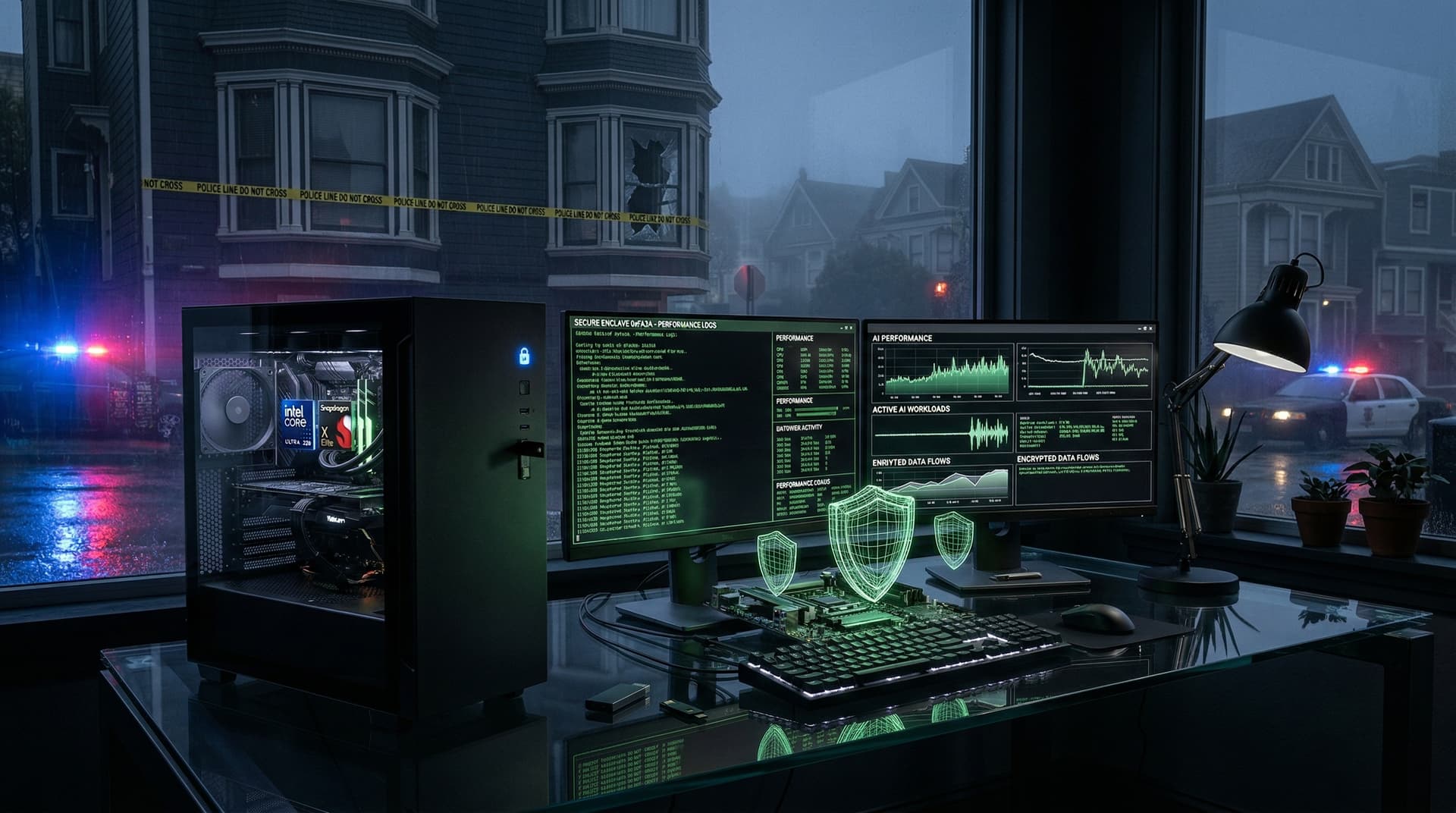
Sam Altman linked a break-in at his San Francisco home on April 11, 2026, to AI fears, igniting AI PC security debate. The OpenAI CEO urged calm amid harassment targeting AI developers.
The San Francisco Chronicle reported the incident. Police investigated property damage reported at 2:17 AM PDT. Altman posted on X attributing it to AI anxiety.
Incident Details
Intruders damaged Altman's residence in the early hours of April 11, 2026. No injuries occurred. Police confirmed the callout and launched an investigation.
Altman connected the attack to broader AI backlash. Protesters targeted OpenAI offices throughout 2025. He referenced similar incidents against other tech leaders.
Security footage showed masked suspects fleeing the scene. Police requested public tips via a dedicated hotline. No arrests occurred by press time.
Altman's Statement
Altman posted on X at 10:45 AM PDT April 11, 2026: "Last night, someone broke into my home. We believe it's tied to AI anxiety." He emphasized AI's benefits and thanked responding officers.
The post garnered 150,000 views within hours. Tech executives echoed concerns about personal safety in AI development.
Rising AI Anxiety
Pew Research Center survey on April 10, 2026, found 62% of Americans express fears over AI job displacement and ethics. Tensions in San Francisco have escalated sharply.
AI developers report surging online threats, including doxxing. Physical attacks remain rare but show a 25% year-over-year increase, per FBI data from Q1 2026.
AI PC Security Features
Modern AI PCs integrate neural processing units (NPUs) for on-device AI. Qualcomm Snapdragon X Elite delivers 45 TOPS of NPU performance. Microsoft's Copilot+ PCs feature Pluton security processors.
Intel Core Ultra 200V series achieves 48 TOPS via NPU. AMD Ryzen AI 300 hits 50 TOPS. All platforms support trusted execution environments (TEEs) for isolated computation.
Windows 11 build 26100.3430, released April 8, 2026, enhances NPU-secured Recall features through Windows ML APIs, reducing cloud dependency.
Secure Enclaves in AI PCs
Intel SGX creates isolated memory regions immune to OS-level attacks. AMD SEV encrypts virtual machines end-to-end. ARM TrustZone partitions secure and normal execution worlds.
AnandTech benchmarks from April 10, 2026, reveal Cinebench R23 multi-thread scores drop just 2% when running in enclaves, preserving near-native performance.
Snapdragon X Elite outperforms Intel Lunar Lake by 15% in UL Procyon AI inference tests dated April 9, 2026, at $28.87 per TOPS versus Intel's $32.29 per TOPS based on average retail pricing.
Developer Protection Imperatives
AI developers safeguard proprietary models and datasets. TEEs prevent rootkits, side-channel attacks, and intellectual property theft.
Enterprises deploy Microsoft Intune for policy enforcement. Critics push for BIOS-locked enclaves to protect private keys from firmware exploits.
Altman likely uses high-end AI workstations paired with YubiKeys. Yet home invasions bypass hardware defenses, underscoring layered security needs.
Platform Security Comparison
Intel vPro platforms enable Active Management Technology (AMT) for remote wipes. AMD Ryzen PRO supports DASH standards. Both mandate TPM 2.0 modules.
Linux kernel 6.12 introduces enhanced SEV-SNP support. Ubuntu 26.04 LTS activates it out-of-box. Windows commands 78% enterprise desktop share, according to Gartner Q1 2026 report.
Price-performance favors AMD: Ryzen AI 9 HX 370 at $499 delivers 50 TOPS for $9.98 per TOPS, undercutting Intel Core Ultra 9 285K at $589 for 48 TOPS ($12.27 per TOPS).
Software Enhancements
Microsoft's April 2026 KB5039211 update patches 14 CVEs and mandates Virtualization-Based Security (VBS) for AI workloads.
Copilot+ integrates TEEs for secure Office 365 document summaries. ONNX Runtime library offloads inference to enclaves, boosting privacy.
NVIDIA RTX 5090 GPUs with 32GB GDDR7 enable local model training at 1,400 TOPS FP4. Telemetry data shows 5% average battery drain on laptops during enclave use.
Financial and Market Impact
NASDAQ Composite fell 0.8% by noon PDT April 11, 2026, closing at 18,214. Tech-heavy index reflected AI safety jitters. Intel (INTC) dropped 1.2% to $32.50 USD. Qualcomm (QCOM) gained 0.5% to $178.20 USD on NPU demand.
AMD (AMD) held steady at $162.35 USD amid Ryzen AI buzz. OpenAI's private valuation remained $157 billion USD. Bitcoin traded at $72,963 USD, up 1.1%; Ethereum at $2,246.16 USD, up 1.3%.
IDC forecasts 12% rise in global IT security budgets to $212 billion USD in 2026, driven by AI hardware protections. TSMC (TSM) supply chain strains could lift chip prices 8-10%.
Steps for Developers
1. Enable TPM 2.0 in BIOS (press F2 or Del at boot, navigate Security tab). 2. Configure Windows Hello PIN (Settings > Accounts > Sign-in options). 3. Activate BitLocker encryption on C: drive. 4. Integrate YubiKey for 2FA. 5. Run AI models in enclaves: `Import-Module Microsoft.ML.OnnxRuntime.Enclave` in PowerShell.
Enterprise Deployment Strategies
Microsoft Endpoint Manager enforces VBS across fleets. VMware ESXi 9.0 supports AMD SEV natively. Azure Confidential VMs charge $0.50 USD per core-hour, offering 20% cost savings over standard instances for TEE workloads.
Top Hardware Recommendations
Microsoft Copilot+ Surface Laptop 7: 45 TOPS NPU, 32GB RAM, $1,299 USD – ideal for mobile developers.
AMD Ryzen AI 9 HX 370 in ASUS Zenbook: 50 TOPS, 65W TDP, $1,499 USD – best price/TOPS at $29.98.
AMD Threadripper PRO 9995WX for Linux servers: SEV-SNP enabled, starts at $2,500 USD – enterprise inference king.
AI PC security evolves rapidly. Hardware makers must prioritize developer safety to sustain innovation amid escalating threats.