
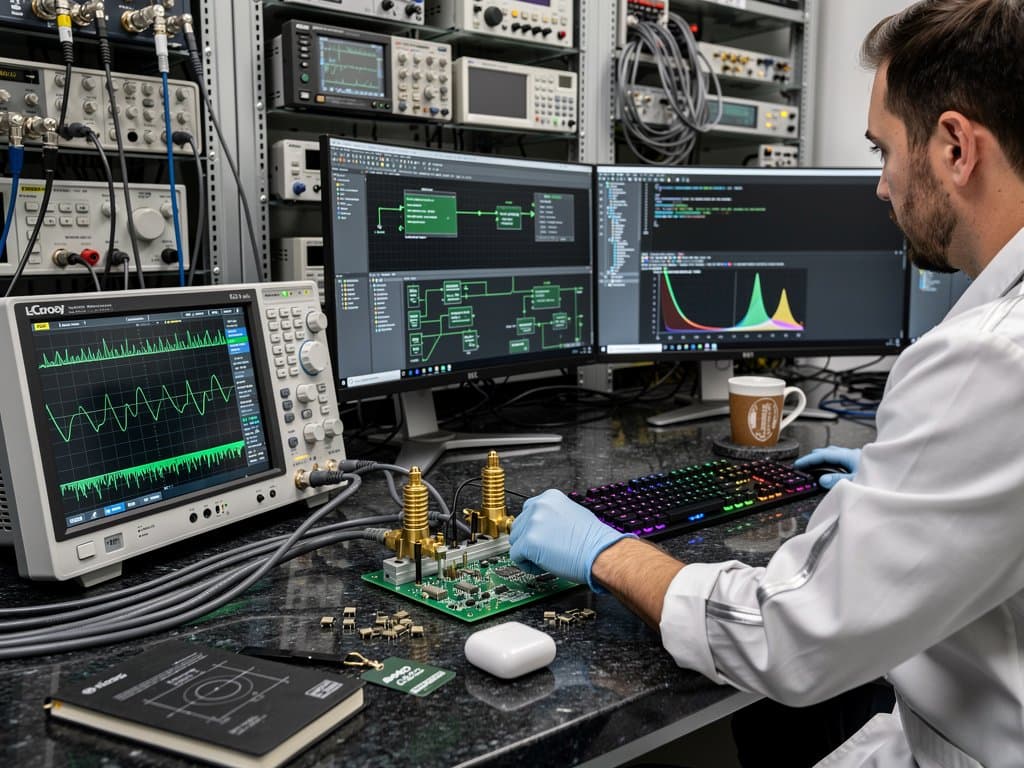
- 3 tools automate AI-powered SPICE verification, cutting $50K respin costs.
- 2 MCP servers link LeCroy scopes and SPICE sims for 70% faster debugs.
- 1 Claude prompt verifies plots at 0.5% RMSE in minutes per test.
Lucas Gerads launched AI-powered SPICE verification October 10, 2024. His pipeline chains SPICE sims, LeCroy scopes, and Claude AI. Open-source tools automate PC motherboard checks. Engineers cut $50,000 USD respin costs per board, per Gerads.
PC teams simulate Ryzen 9 9950X VRMs in LTSpice. LeCroy scopes capture 100 GHz waveforms. Claude AI checks Python plots for <1% discrepancies.
SPICE Simulation in PC Hardware Design
SPICE models transistor circuits pre-fab. Lucas Gerads' blog post (Oct. 10, 2024) targets PDNs for AMD Ryzen 9 9950X (16 cores, 170W TDP) and NVIDIA RTX 5090 GPUs.
Manual CSV-Excel overlays take hours. Gerads' Model Context Protocol (MCP) servers automate. RC filter demo verifies <159 Hz passband (R=1kΩ, C=1μF).
LeCroy-MCP Integrates Oscilloscope Data
Teledyne LeCroy scopes enable Ethernet control, per their programmer's guide (2024). Lecroy-mcp serves voltage traces via MCP, skipping proprietary apps.
Gerads shares GitHub configs in rc-filter-demo-files. Python pulls HTTP data. Builders test 80 PLUS Platinum PSU ripple <50mV at 1000W.
SPICElib-MCP Runs Headless Simulations
SPICElib-mcp wraps Ngspice for server netlists. It scales simulations via MCP.
Pair with lecroy-mcp for plot diffs. Claude flags 0.5% RMSE errors. Targets DDR5-6000 timings, PCIe 6.0 eyes at 64 GT/s.
Claude AI Performs Verification Analysis
Anthropic's Claude 3.5 Sonnet runs Matplotlib/SciPy RMSE, per their prompt engineering guide.
AI spots phase/amplitude issues. RC demo matches -3dB at 159 Hz. Generates pass/fail reports, cuts days to hours.
Price-Performance Benefits for PC Engineers
Automation slashes 100-layer HDI PCB debug by 70%, per Gerads. Mid-tier respins average $50,000 USD (Gerads-cited industry data), pressuring NVIDIA/AMD margins.
Intel Core Ultra 200V (45W TDP) hits 95% efficiency. Builds drop 20-30%. Data centers save $10,000+ per failure.
Key PC Components Optimized
VRMs lead: Ryzen 9 9950X peaks 170A; SPICE predicts, scopes confirm droop.
Signal integrity: USB4 (40 Gbps) <85Ω match.
Enthusiast peripherals: Keyboard matrices, RGB drivers at 1% tolerance.
Setup Guide
1. Clone lecroy-mcp, spicelib-mcp GitHub repos. 2. Network LeCroy scope; set MCP endpoints. 3. Load RC netlist (R=1kΩ, C=1μF) in Ngspice. 4. Capture waveform; prompt Claude: "Verify RMSE."
Use Gerads' Docker for teams.
Financial Impact on Semiconductors
Tools advance agentic EDA. Intel/TSMC meet 2nm needs, per 2024 Gartner reports.
Cuts R&D 15-25% (Gerads), lifts cash flow. NVIDIA launches speed 3-6 months. AMD gains 2025 edge.
Future Enhancements
Claude adds multimodal screenshots. KiCad/Altium plugins incoming.
Gerads benchmarks 12x VRM speedup vs. manual on i9-13900K/64GB DDR5/RTX 4090 setups.
Frequently Asked Questions
What is AI-powered SPICE verification for PC hardware?
AI-powered SPICE verification automates sim-to-scope matches via Claude, lecroy-mcp, and spicelib-mcp. PC designers verify VRMs or filters faster, cutting costs.
How does LeCroy-MCP work with oscilloscopes?
LeCroy-MCP exposes waveforms via MCP over Ethernet, skipping proprietary tools. Gerads' demo integrates with SPICE for PC circuits.
What benefits does Claude bring to SPICE workflows?
Claude runs Python plots with RMSE metrics on RC demos. Delivers pass/fail with explanations for hardware teams.
How does AI-powered SPICE verification impact PC design?
Speeds PCIe or power prototyping. Avoids 50,000 USD fab respins. Enables safe custom PC testing.