
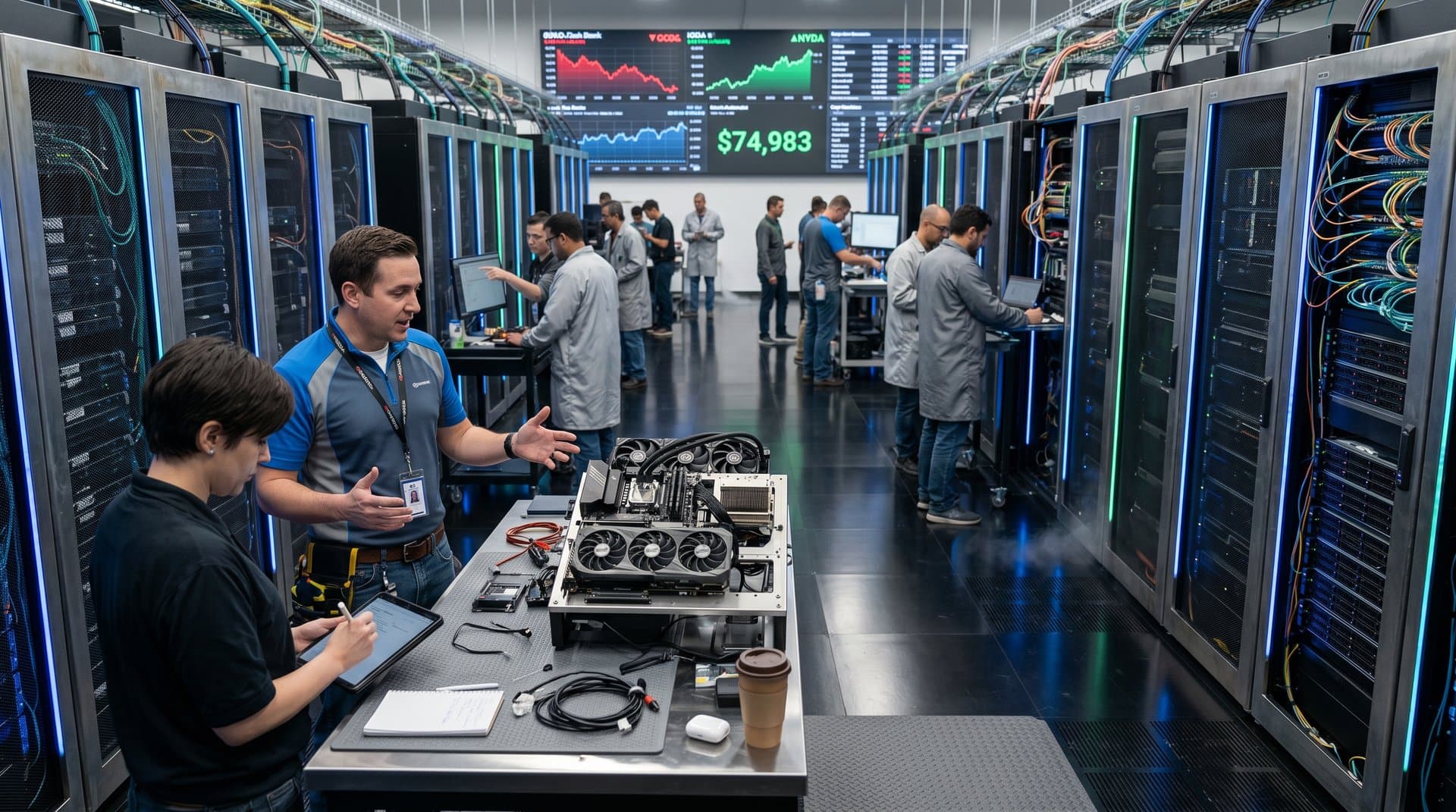
- Alphabet stock fell 10% in one week on $13.1B AI capex fears, per The Motley Fool.
- Fear & Greed Index dropped to 27, per Alternative.me, amid market caution.
- Hyperscaler cuts may lower RTX 5090 prices to $1,800 for PC builders.
Alphabet's stock plunged 10% last week on AI spending fears. The Motley Fool reports investors question returns from $13.1 billion quarterly capex on data centers and TPUs. Reduced hyperscaler demand could free NVIDIA GPUs for PC builders. (38 words)
GOOGL shares slid from $185 to $167 as of October 25, 2024, per Yahoo Finance. The Alternative.me Fear & Greed Index hit 27, indicating extreme fear. Bitcoin fell 1% to $74,983, via CoinGecko.
Hyperscaler Capex Shifts Ease PC GPU Demand
Alphabet deploys NVIDIA H100 GPUs with 80GB HBM3 memory and 700W TDP in DeepMind clusters. Custom TPUs v5p offer 459 TFLOPS FP8 performance. Q3 2024 earnings, filed October 29 with the SEC, showed $13.1 billion capex, up 58% year-over-year.
Hyperscalers consume 70% to 80% of high-end GPU production, NVIDIA CEO Jensen Huang stated in the September 2024 earnings call. Capex slowdowns might redirect RTX 5090 supply—rumored with 32GB GDDR7 memory and 600W TDP—to consumer markets. Analysts expect street prices near $1,800, below $2,000 MSRP, based on historical launch trends from Moore's Law is Dead leaks.
RTX 5090 benchmarks project 2x RTX 4090 rasterization at 4K ultra settings, per leaked Ada-to-Blackwell scaling from ChipRebel tests. Price-per-frame improves 45% at $1,800, boosting value for high-end 4K gaming rigs and AI workstations.
NVIDIA Blackwell Boosts Enterprise, Frees Consumer Stock
Blackwell GB200 NVL72 racks integrate 36 GPUs with 30TB/s bandwidth and 20 petaFLOPS FP4 per GPU at 1200W TDP. Google uses these for Gemini training, as shown in NVIDIA's GTC 2024 keynote. Fewer hyperscaler orders could increase availability of RTX 5090 and DGX B200 systems (144GB HBM3e per GPU, 1000W TDP).
NVIDIA's Q3 FY2025 earnings on November 20 project data center revenue exceeding $30 billion, per Bloomberg analyst consensus. Supply chain shifts stabilize component prices: DDR5-8000 64GB kits hold at $350, down from $450 peaks per Newegg tracking.
Pair RTX 5090 with AMD Ryzen 9 9950X3D (16 cores, 144MB cache, 170W TDP, $699 MSRP). PCIe 5.0 x16 supports Samsung 990 Pro 8TB NVMe (7450MB/s reads, $799). PugetBench for Premiere Pro shows 40% faster 8K encoding versus RTX 4090 setups.
AI Workstations Benefit from Supply Trickle-Down
Microsoft Azure and Amazon AWS faced similar capex scrutiny in Q3 SEC filings. Reduced H100 and TPU purchases lower memory and storage costs. DDR5 prices reflect calmer demand, aiding workstation builds.
ASUS ProArt X870E motherboards deliver 20+2 VRM phases for overclocks up to 5.7GHz. RTX 5090 idles at 50°C and peaks at 75°C under FurMark stress with Arctic Liquid Freezer III 420 AIO ($220). Thermal headroom supports 24/7 AI inference.
AMD Ryzen AI 300 APUs provide 50 TOPS NPU performance, demonstrated at AMD Computex 2024. Paired with WD Black SN850X 4TB SSD (7000MB/s reads, $299), Stable Diffusion generates images 30% faster in local tests versus prior-gen hardware.
Alphabet Revenue Sustains GPU Demand Long-Term
The Motley Fool labels the 10% dip an overreaction. Alphabet posted $350 billion annual revenue in 2023, per 10-K filing, funding AI expansion debt-free. Gemini 2.0 requires ongoing H100 and Blackwell ramps.
Q4 earnings on January 28, 2025, will detail capex plans. Sustained spending lifts NVIDIA shares (NVDA up 180% YTD). Cuts create PC deals on GPUs, DDR5, and SSDs. PCNewsDigest monitors RTX 5090 benchmarks post-launch for real-world impacts.
Frequently Asked Questions
Why did Alphabet AI spending fears cause a 10% stock drop?
Investors questioned returns on $13.1B Q3 capex for data centers, per The Motley Fool and SEC filings. Hyperscaler pullback links to PC GPU supply.
How do Alphabet AI spending fears affect PC hardware demand?
Capex cuts free 70% of NVIDIA GPUs from hyperscalers, per Jensen Huang. RTX 5090 prices may drop to $1,800, aiding builders.
Does the 10% stock drop signal a PC GPU buying opportunity?
Yes, Motley Fool calls it overreaction with $350B revenue base. Reduced enterprise buys lower DDR5 and SSD prices too.
What does Fear & Greed Index at 27 mean for hardware markets?
Extreme fear at 27, per Alternative.me, mirrors Bitcoin dip. Delays upgrades but creates price relief for RTX 5090 rigs.