
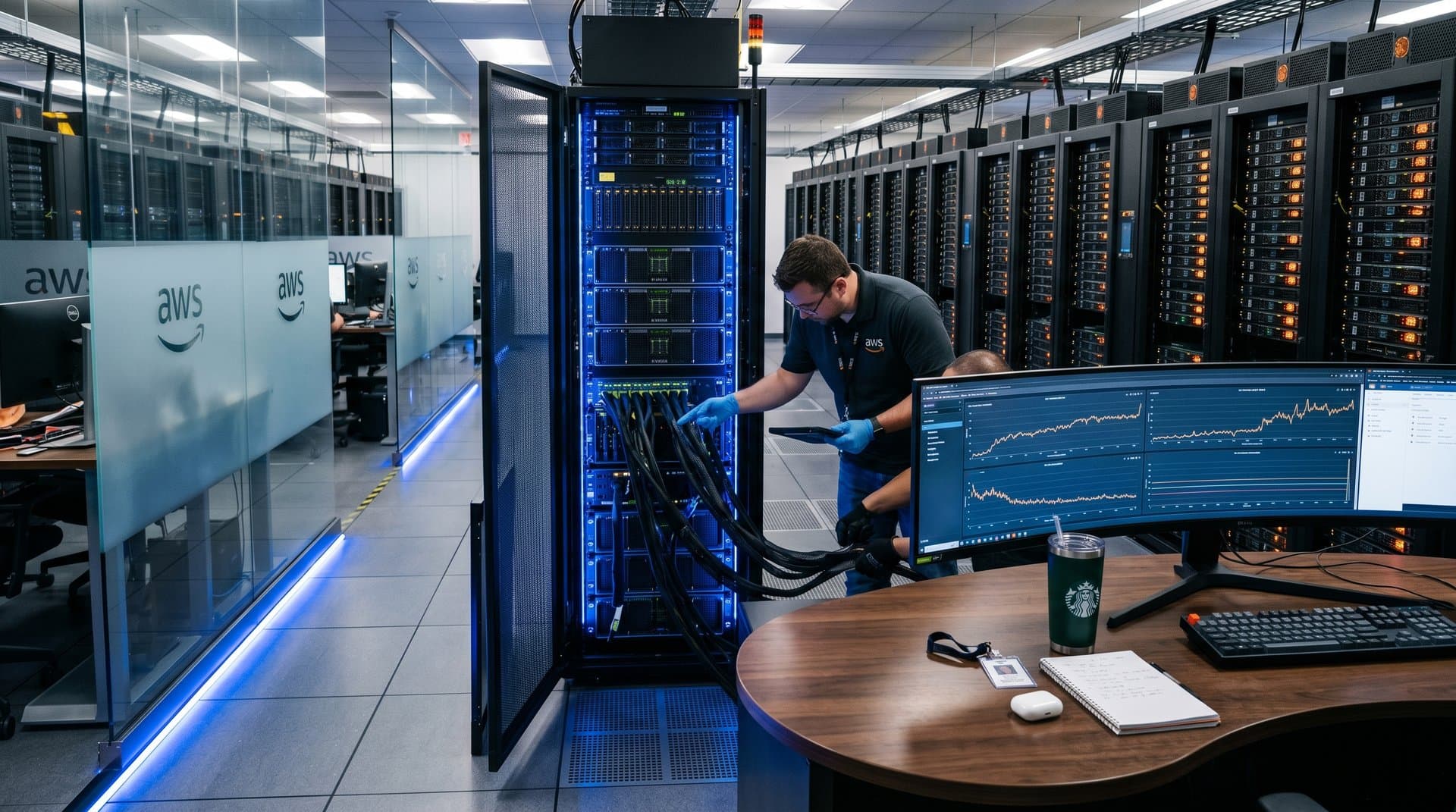
- Amazon invests up to $4 billion more in Anthropic for AWS AI.
- Demand surges for 80GB H100 GPUs at 700W TDP in clusters.
- Blackwell B200 offers 192GB HBM3e, doubling prior memory specs.
Amazon expands Anthropic investment by up to $4 billion more, per CNBC on November 22, 2024. This deal builds on prior $4 billion funding. AWS deploys funds to scale AI infrastructure with Trainium, Inferentia, and NVIDIA GPUs. Server demand spikes for premium components.
AWS commands over 50% market share in AI training jobs, per Statista Q3 2024 data. Anthropic's growth strains high-end GPU supplies. IT teams stock DDR5 RAM up to 2TB per server and PCIe 5.0 risers. NVIDIA Blackwell GPUs lead specification lists.
Amazon Anthropic Investment Supercharges AWS UltraClusters
Amazon directs funds to satisfy Anthropic's AWS compute needs. Frontier AI models demand thousands of GPUs per cluster. AWS Trainium2 chips deliver 4x performance over Inferentia, per AWS re:Invent 2024 benchmarks.
Engineers assemble EC2 UltraClusters with millions of chips. NVIDIA H100 SXM GPUs provide 80GB HBM3 memory at 700W TDP, per NVIDIA datasheets. Blackwell B200 doubles capacity to 192GB HBM3e. On-premises admins pair them with AMD EPYC CPUs.
Anthropic's AWS announcement details the scale. Claude 4 targets 2026 release. Bedrock users run models without custom infrastructure builds.
High-End GPUs Dominate AWS-Anthropic AI Workloads
NVIDIA Hopper and Blackwell GPUs populate AWS racks. H100 SXM hits 3,958 TFLOPS in FP8 precision, per NVIDIA specifications. GB200 NVL72 racks integrate 72 GPUs for 1.4 exaFLOPS at 120kW power draw.
AMD MI300X supplies 192GB HBM3 at 5.3 TB/s bandwidth. Servers use 128-core AMD EPYC 9755 processors at 500W TDP, per AMD product brief. Intel Gaudi3 offers 128GB HBM2e for inference tasks.
AWS Machine Learning blog post details Claude 3 integration on Bedrock. Demand shifts to 48GB RDIMMs and 14GB/s NVMe Gen5 SSDs.
Price-performance tilts to NVIDIA: H100 clusters achieve 1.5-2x better inference throughput per dollar than AMD, per MLPerf benchmarks Q3 2024.
AWS AI Expansion Impacts PC Servers and Workstations
Anthropic's expansion squeezes global GPU supply. NVIDIA targets Blackwell production at 500,000 units per quarter by mid-2026, per Q3 2024 earnings filings. OEMs like Dell and Supermicro favor hyperscaler orders.
PC builders pay 20-30% premiums on RTX 5090 GPUs. Lenovo ThinkStation P8 workstations pack dual RTX 6000 Ada GPUs, 96GB RAM, and Intel Xeon w9-3595X CPUs. These setups slash cloud inference costs by 40-50%.
Windows Server 2026 adds DirectML acceleration. VMware vSphere 9 enables 8-GPU NVLink configurations.
Supply Chain Strains from Amazon Anthropic Investment
AI clusters require petabyte-scale storage. Servers equip 100TB Samsung PM1743 QLC SSDs. Motherboards handle 16 DIMMs with 8TB Micron DDR5-8800.
Liquid cooling tames 1kW-per-GPU heat. Noctua NH-U14S coolers suit EPYC sockets. Seasonic 2kW Titanium PSUs drive full racks.
NVIDIA H100 datasheet verifies specifications. TSMC ramps 4NP+ process for Blackwell. AWS cements AI leadership amid supply risks. The Amazon Anthropic investment secures multi-year dominance in AI hardware markets.
Frequently Asked Questions
What is the Amazon Anthropic investment amount?
Amazon's latest Amazon Anthropic investment adds up to $4 billion. It expands AWS AI infrastructure with Trainium chips. This builds on prior funding for Claude model training.
How does the Amazon Anthropic investment impact AWS GPU demand?
The Amazon Anthropic investment drives demand for thousands of H100 and Blackwell GPUs in UltraClusters. It supports petascale AI training jobs. Supermicro server orders increase sharply.
What PC server components benefit from AWS AI boom?
Blackwell B200 GPUs with 192GB HBM3e lead demand. Pair with 128-core EPYC 9755 CPUs, DDR5-8800 RAM, and Gen5 NVMe SSDs in racks. They enable efficient on-premises inference.
Why choose AWS for Anthropic's AI infrastructure?
Trainium2 chips provide superior TFLOPS efficiency. Custom EC2 instances scale Claude models to exabyte datasets. This avoids multi-vendor lock-in risks.