
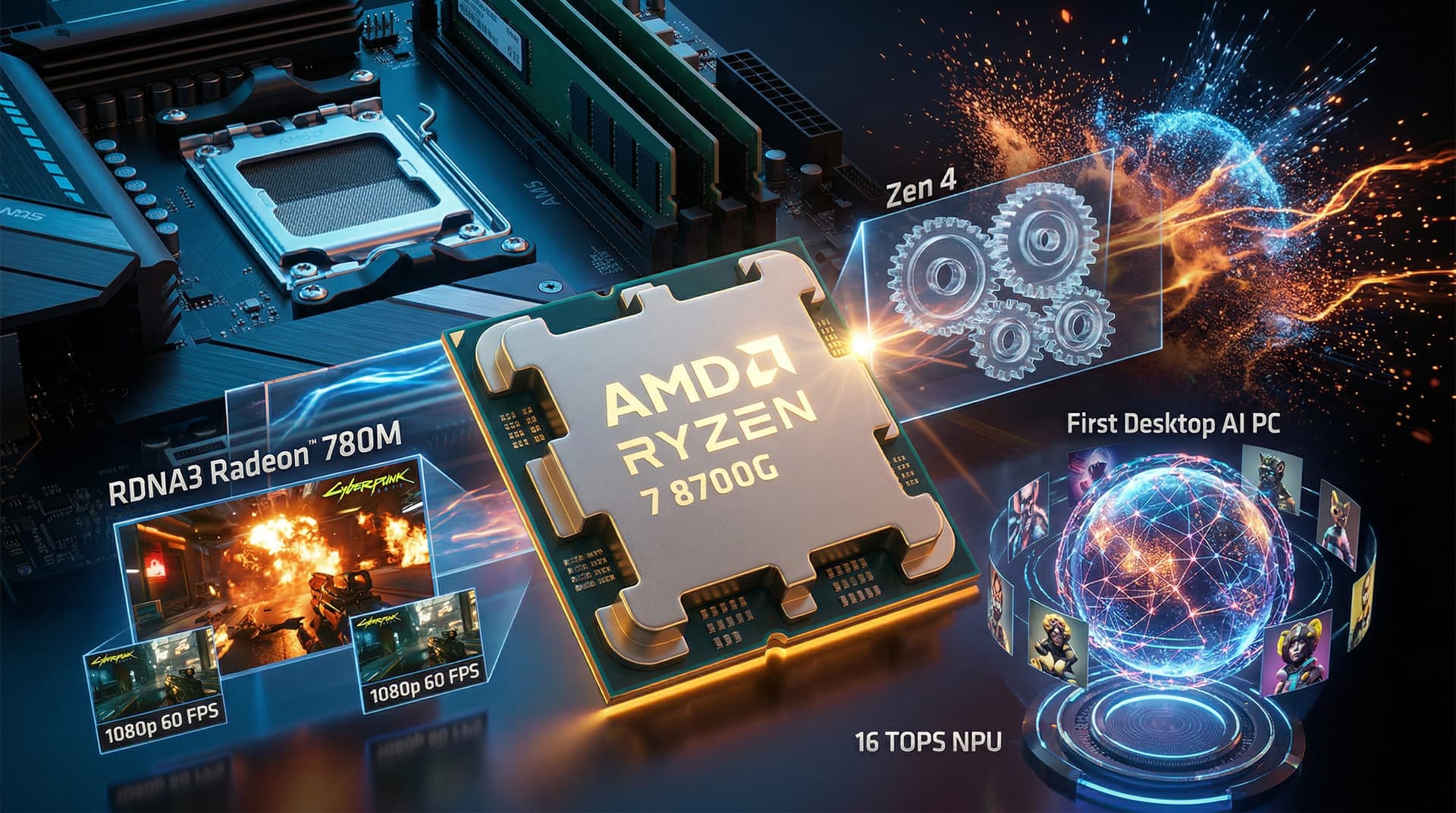
In a significant move for the desktop processor market, AMD announced the Ryzen 8000G series on November 6, 2023, at its AMD Advantage event. These all-in-one processor units (APUs) combine powerful CPU cores, high-end integrated graphics, and—most notably—a dedicated neural processing unit (NPU) for AI acceleration. Aimed at budget-conscious gamers, content creators, and the growing wave of AI PC users, the Ryzen 8000G lineup represents AMD's push to bring advanced features to entry-level and mid-range desktops without requiring discrete graphics cards.
Breaking Down the Specs
The Ryzen 8000G family includes four models: Ryzen 7 8700G, Ryzen 5 8600G, Ryzen 5 8500G, and Ryzen 3 8300G. All are built on TSMC's 4nm process for the compute die and 6nm for the I/O die, delivering efficiency gains over predecessors.
Here's a quick spec rundown:
| Model | Cores/Threads | Base/Boost Clock | iGPU | NPU TOPS | TDP |
|---|---|---|---|---|---|
| Ryzen 7 8700G | 8/16 | 4.2/5.1 GHz | Radeon 780M | 16 | 65W |
| Ryzen 5 8600G | 6/12 | 4.3/5.0 GHz | Radeon 760M | 16 | 65W |
| Ryzen 5 8500G | 6/12 (2 Zen4c) | 3.5/5.0 GHz | Radeon 740M | None | 65W |
| Ryzen 3 8300G | 4/8 (Phoenix) | 3.4/4.9 GHz | Radeon 740M | None | 65W |
The flagship Ryzen 7 8700G stands out with eight full Zen 4 cores, a Radeon 780M iGPU boasting 12 compute units clocked up to 2.9 GHz, and the XDNA NPU delivering up to 16 TOPS of AI performance. This NPU is the same tech found in AMD's Ryzen 7040 mobile series, enabling efficient handling of machine learning tasks directly on the chip.
Integrated Graphics Leap Forward
Gaming on integrated graphics has come a long way, and the Ryzen 8000G pushes boundaries further with RDNA3 architecture. AMD claims the Radeon 780M in the 8700G can deliver over 60 FPS in modern titles like Cyberpunk 2077 at 1080p low settings and handle esports games at high frame rates. Early benchmarks from AMD show it outperforming Intel's latest Arc-equipped iGPUs and even some entry-level discrete cards like the GTX 1650.
For mini-ITX builds, HTPCs, or office PCs, this means viable 1080p gaming without the cost and power draw of a separate GPU. Features like AMD Fluid Motion Frames (AFMF) and HYPR-RX further boost frame rates and image quality via upscaling and optimization.
AI on Desktop: A New Era
The real game-changer is the NPU. While GPUs have handled AI workloads via CUDA or ROCm, the dedicated NPU offloads tasks more efficiently, freeing CPU and GPU for other duties. AMD demonstrated real-time AI image generation using Stable Diffusion, video upscaling, and noise cancellation in apps like OBS Studio.
Microsoft's ONNX Runtime and Windows ML support these NPUs, positioning Ryzen 8000G systems as early "AI PCs." Though not yet Copilot+ certified (that's for higher TOPS), they pave the way for local AI processing in tools like Adobe Photoshop's generative fill or future Windows features. Power efficiency is key: AI inference on NPU uses a fraction of the energy compared to CPU-only execution.
Comparisons and Competition
Compared to the 2022 Ryzen 5000G series (Zen 3, Vega iGPUs), the 8000G offers 2x graphics performance and adds AI capabilities. Against Intel's Core i-series with UHD Graphics, AMD's RDNA3 iGPUs dominate in gaming.
Intel's upcoming Meteor Lake (Core Ultra) brings a similar NPU to laptops first, but AMD strikes first on desktop with consumer pricing. Expect the 8700G at $329, 8600G at $229, down to $99 for the 8300G (OEM-only initially).
Availability and Ecosystem
These APUs launch on January 8, 2024, via motherboards from ASRock, ASUS, Gigabyte, and MSI on AM5 socket (DDR5/LGA 1700? No, AM5). They're backward-compatible with AM4 via BIOS, but full features require AM5 for PCIe 5.0 and best RAM speeds.
Pre-built systems from Lenovo, HP, and others will follow. AMD's Handheld Gaming Initiative partners like ASUS ROG Ally will benefit from similar tech.
Performance Insights from Previews
Leaked and official benchmarks highlight strengths:
- Cinebench R23: 8700G multi-core ~18,000, rivaling older 12-core Ryzen 5000.
- 3DMark Time Spy: ~3,500 graphics score, ahead of Intel's best iGPUs.
- AI Benchmarks: 5-10x faster Stable Diffusion vs. CPU.
In productivity, Handbrake encoding is quicker thanks to Zen 4 IPC gains (13% over Zen 3).
Why It Matters for PC Builders
For budget gamers, the 8000G enables sub-$800 gaming rigs with 1080p capability. Small form factor enthusiasts get powerful iGPUs without blower cards. AI hobbyists can experiment locally, avoiding cloud costs and latency.
AMD's strategy aligns with industry trends: Microsoft pushes NPUs for on-device AI, and regulators favor local processing for privacy. As software optimizes (e.g., DirectML), these APUs will shine brighter.
Potential Drawbacks
No PCIe 5.0 GPU lanes on lower models, and the NPU's 16 TOPS lags behind mobile flagships' 40+. Higher-end users may still want discrete GPUs for 1440p/4K.
Final Thoughts
The Ryzen 8000G series cements AMD's lead in integrated desktop computing. By blending elite iGPUs, efficient Zen 4, and pioneering desktop AI, it democratizes high-performance PCs. Whether building a media center, LAN party machine, or AI tinkerer's rig, these APUs deliver exceptional value. Watch for reviews post-launch to confirm the hype—AMD's track record suggests they won't disappoint.
Word count: 912