
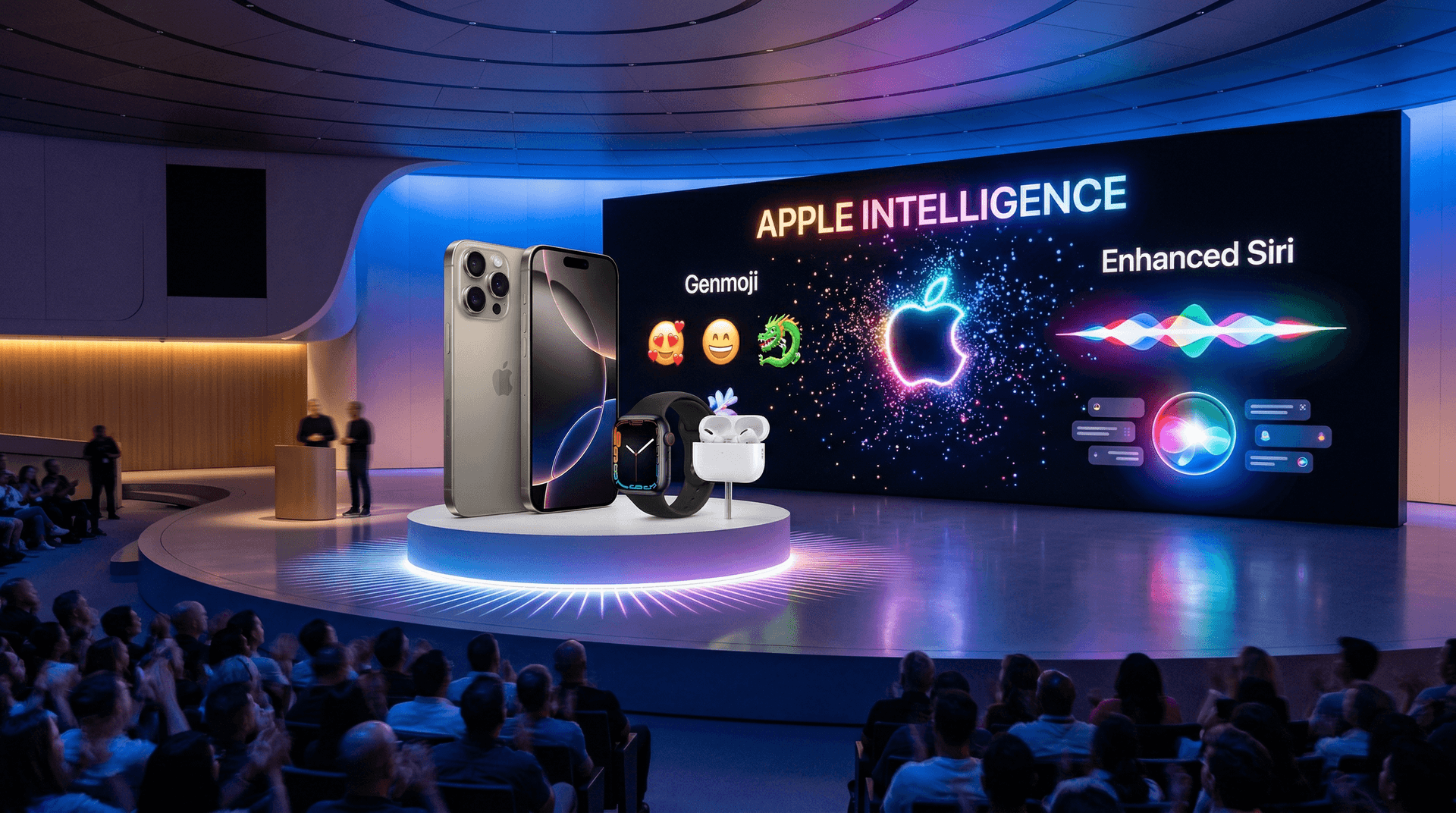
On September 9, 2024, Apple lit up its Cupertino headquarters with the 'Glowtime' event, unveiling the highly anticipated iPhone 16 series. This launch marks a pivotal shift towards on-device AI with Apple Intelligence, blending cutting-edge hardware and software in a lineup that's set to redefine smartphone gadgets. While PC enthusiasts await M-series Mac updates, these iOS devices promise seamless integration with Apple's ecosystem, including enhanced cross-device features.
iPhone 16 and 16 Plus: Power-Packed Everyday Gadgets
The base iPhone 16 and 16 Plus kick off the series with Apple's new A18 chip, built on a 3nm process for superior efficiency and performance. This Bionic processor isn't just faster—it's the foundation for Apple Intelligence, Apple's suite of generative AI tools. Features like Writing Tools for text summarization and proofreading, Image Playground for creating images from prompts, and an upgraded Siri with personal context awareness will roll out via iOS 18 updates starting in October.
Design-wise, the iPhone 16 sports a refreshed look with vertical camera alignment for spatial video capture, compatible with Vision Pro. A standout addition is the Camera Control button—a capacitive touch surface on the right side that lets users swipe for quick zoom, launch the camera app, or access visual intelligence features. It supports haptic feedback and customizable actions, making it a game-changer for photographers on the go.
Camera upgrades include a 48MP Fusion main sensor with 2x telephoto via crop, a 12MP ultrawide with macro capabilities, and improved low-light performance. Colors pop with new hues like Ultramarine and Teal for the standard models. Battery life sees gains from the efficient A18, and both models support USB-C with up to 2TB storage options.
Pricing remains steady: iPhone 16 starts at $799, 16 Plus at $899— a welcome relief amid inflation pressures.
iPhone 16 Pro and Pro Max: Pro-Level Gadgets for Creators
For power users, the iPhone 16 Pro (6.3-inch) and Pro Max (6.9-inch) elevate the game with the A18 Pro chip, packing a 6-core CPU, 6-core GPU, and 16-core Neural Engine delivering 45 TOPS for AI workloads. These are the first iPhones with frame-by-frame video stabilization and 4K 120fps Dolby Vision recording, courtesy of a new Camera Control system.
Displays are brighter (up to 2000 nits peak) with always-on 120Hz ProMotion and thinner bezels. The Pro Max's massive 6.9-inch screen is Apple's largest ever, ideal for media consumption and productivity. New Desert Titanium color joins the lineup.
The camera array shines: 48MP main, 48MP ultrawide, and 12MP 5x telephoto. Audio zoom and studio-quality video tools cater to content creators. All models boast IP68 water resistance and Aerospace-grade titanium frames.
Starting at $999 for Pro and $1,199 for Pro Max, pre-orders began September 13, with shipping September 20.
Apple Watch Series 10: Thinnest, Smartest Wearable Yet
Complementing the iPhones, the Apple Watch Series 10 is 1mm thinner at 9.7mm, with the largest display ever—a wide-angle LTPO3 OLED up to 30% more screen area. Available in 42mm and 46mm sizes, it features up to 2000 nits brightness and ultra-thin bezels.
Health features expand with a depth gauge and water temperature sensor for snorkeling up to 6m, plus sleep apnea detection via breathing disturbance analysis. The S10 SiP enables on-device Siri and doubles as a translation device. Battery life hits 18 hours with fast charging to 80% in 30 minutes.
New Jet Black and Rose Gold finishes, plus Milanese Loop bands, add style. Pricing: $399 for GPS, $499 for Cellular.
The Apple Watch Ultra 2 gets a new black titanium option with matching bands, maintaining its rugged appeal at $799.
AirPods Pro 2: ANC Perfected
AirPods Pro 2 receive a firmware boost with Personalized Spatial Audio improvements and Adaptive Audio refinements. Active Noise Cancellation is now twice as effective, blocking twice the sound compared to previous generations. Hearing Aid mode and Hearing Protection features roll out via software, pending regulatory approval.
Transparency mode adapts to environments, and head gestures control calls. Priced at $249, they're a must-have accessory.
Apple Intelligence and Ecosystem Ties
Apple Intelligence is the star, processing most tasks on-device for privacy. Genmoji creation, Clean Up in Photos, and Priority Notifications use the Neural Engine. Integration with ChatGPT (opt-in) handles complex queries. iOS 18, watchOS 11, and more bring customization like tinted icons and Control Center widgets.
For PC users, these gadgets sync effortlessly with macOS Sequoia via Continuity, enabling iPhone Mirroring on M-series Macs—control your iPhone from your Mac desktop.
What It Means for Gadget Lovers
Apple's September event delivers evolutionary upgrades focused on AI and usability. No revolutionary redesigns, but iterative perfection in cameras, batteries, and smarts positions the iPhone 16 as a longevity champ with 7+ years of support.
Competition heats up with Pixel 9's AI and Samsung's foldables, but Apple's privacy-first approach and ecosystem lock-in remain unbeatable. As AI gadgets proliferate, expect these to influence PC hardware trends like NPUs in Intel Lunar Lake and Qualcomm Snapdragon X.
Pre-orders are live, and with holiday season approaching, these gadgets will dominate wishlists. Stay tuned to PC News Digest for hands-on reviews and comparisons.
Word count: 912