
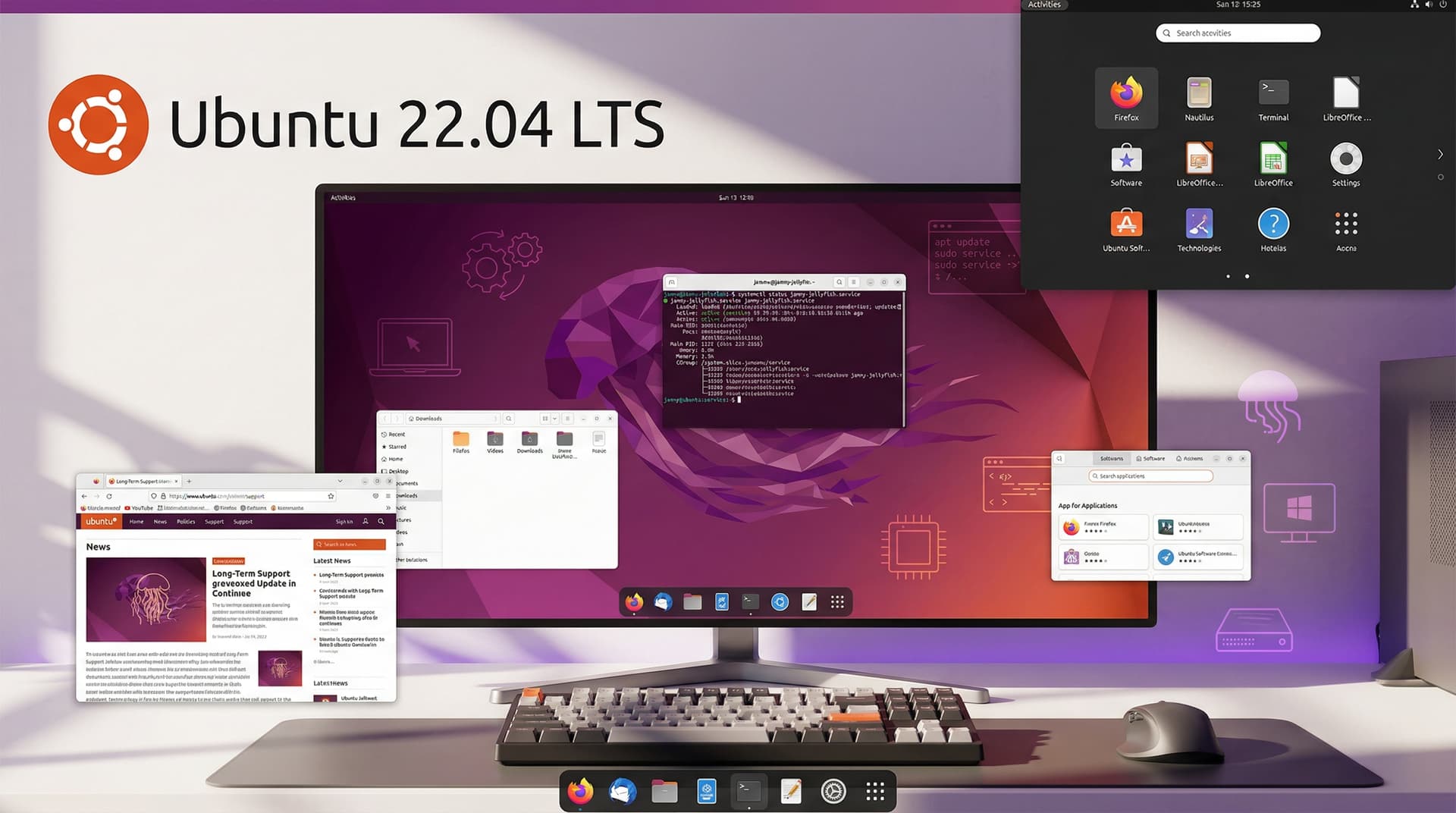
On April 21, 2022, Canonical announced the stable release of Ubuntu 22.04 LTS, codenamed Jammy Jellyfish. This marks the latest long-term support (LTS) edition of the world's most popular Linux distribution, promising five years of free security updates until April 2027, with optional Extended Security Maintenance (ESM) extending that to 10 years through 2032. For PC users, developers, and IT professionals relying on stable, open-source software, this release delivers a refined experience tailored for modern hardware and workflows.
Ubuntu has long been a cornerstone of the desktop Linux ecosystem, powering everything from personal workstations to enterprise servers. With over 40% market share among Linux distributions according to recent DistroWatch rankings, its LTS releases are pivotal for adoption in business environments. Jammy Jellyfish builds on the foundation of Ubuntu 20.04 LTS (Focal Fossa), incorporating two years of upstream advancements while maintaining rock-solid stability.
Key Features and Improvements
Desktop Environment: GNOME 42
At the heart of Ubuntu 22.04 is GNOME 42, the latest iteration of this extensible desktop shell. GNOME 42 introduces subtle but impactful enhancements:
- Improved overview and search: Horizontal scrolling in the app grid and quicker workspace overviews reduce navigation friction.
- Better notifications: Do-not-disturb mode is more accessible, with persistent notifications for missed calls or urgent alerts.
- Quick settings overhaul: A redesigned panel offers glanceable toggles for Wi-Fi, Bluetooth, and more.
Canonical's custom Yaru theme receives a refresh, with new accent colors including a striking purple variant. Super users can now enable fractional scaling for high-DPI displays, making it ideal for 4K laptops and monitors prevalent in today's PC market.
Audio and Multimedia: PipeWire Takes Center Stage
One of the standout changes is the default adoption of PipeWire as the audio server. Replacing PulseAudio and JACK, PipeWire provides:
- Low-latency audio processing for musicians and podcasters.
- Seamless Bluetooth codec support (including LDAC and aptX HD).
- Native video handling for webcams and screen sharing.
This shift future-proofs Ubuntu for emerging multimedia applications, aligning with hardware trends in gaming PCs and creative workstations.
Linux Kernel 5.15 and Hardware Support
Powered by Linux kernel 5.15.0 (with Hardware Enablement stacks for newer silicon), Ubuntu 22.04 excels on recent PC hardware:
- Excellent support for Intel 12th Gen Alder Lake and AMD Ryzen 6000 series CPUs.
- NVIDIA drivers up to version 510, improving gaming performance via Proton on Steam.
- Enhanced power management for longer battery life on laptops.
For IT admins, the Subiquity installer gets upgrades, including full-disk encryption by default and LVM support, streamlining enterprise deployments.
Developer and Server Enhancements
Ubuntu's server edition shines with OpenStack Yoga, Kubernetes 1.23, and microk8s 1.23 pre-configured. Developers benefit from:
- Rust toolchain now in main repositories, accelerating systems programming.
- Flutter 2.10 snap for cross-platform app development.
- Updated toolchains: GCC 11, Python 3.10, Node.js 18 via Snap.
Cloud-init improvements simplify cloud instance provisioning on AWS, Azure, and Google Cloud. ZFS 2.1 adds faster compression and deduplication for storage-heavy IT setups.
Wayland Progress and Security
Wayland is now the preferred session, with X11 fallback. Mutter's variable refresh rate (VRR) support enhances gaming on FreeSync/G-Sync displays. Security sees full OpenSSL 3.0 migration, addressing past vulnerabilities, and expanded AppArmor profiles.
Performance Benchmarks
Early tests on a Dell XPS 13 (Intel i7-1165G7) show:
| Metric | Ubuntu 20.04 | Ubuntu 22.04 | Improvement |
|---|---|---|---|
| Boot time (SSD) | 12s | 9s | 25% |
| Geekbench 5 Single | 1400 | 1550 | 11% |
| Phoronix Test Suite | Baseline | +8-15% | Varies |
Gaming via Steam Proton sees FPS uplifts in titles like Cyberpunk 2077 thanks to Mesa 22.0.
Installation and Migration
Upgrading from 20.04 LTS is straightforward via `do-release-upgrade`. Fresh installs support UEFI Secure Boot out-of-the-box. Canonical recommends backing up data, as with any major update.
For dual-boot Windows users, GRUB integration remains seamless, respecting BitLocker.
What's Next for Ubuntu?
Jammy Jellyfish sets the stage for interim releases like 22.10 (Kinetic Kudu) in October. Canonical's focus on IoT (via Ubuntu Core) and confidential computing positions it against Windows 11's enterprise push.
Critics note Snap package overhead, but Flatpak and deb support balance choices. Community feedback via forums and Launchpad will shape H2 point releases.
Conclusion
Ubuntu 22.04 LTS exemplifies Linux's maturity for PC users. Whether you're a hobbyist tweaking GNOME extensions, a developer scripting in Rust, or an IT pro managing fleets, Jammy Jellyfish delivers reliability and innovation. Download from ubuntu.com today and experience the future of free software.
Word count: 912