
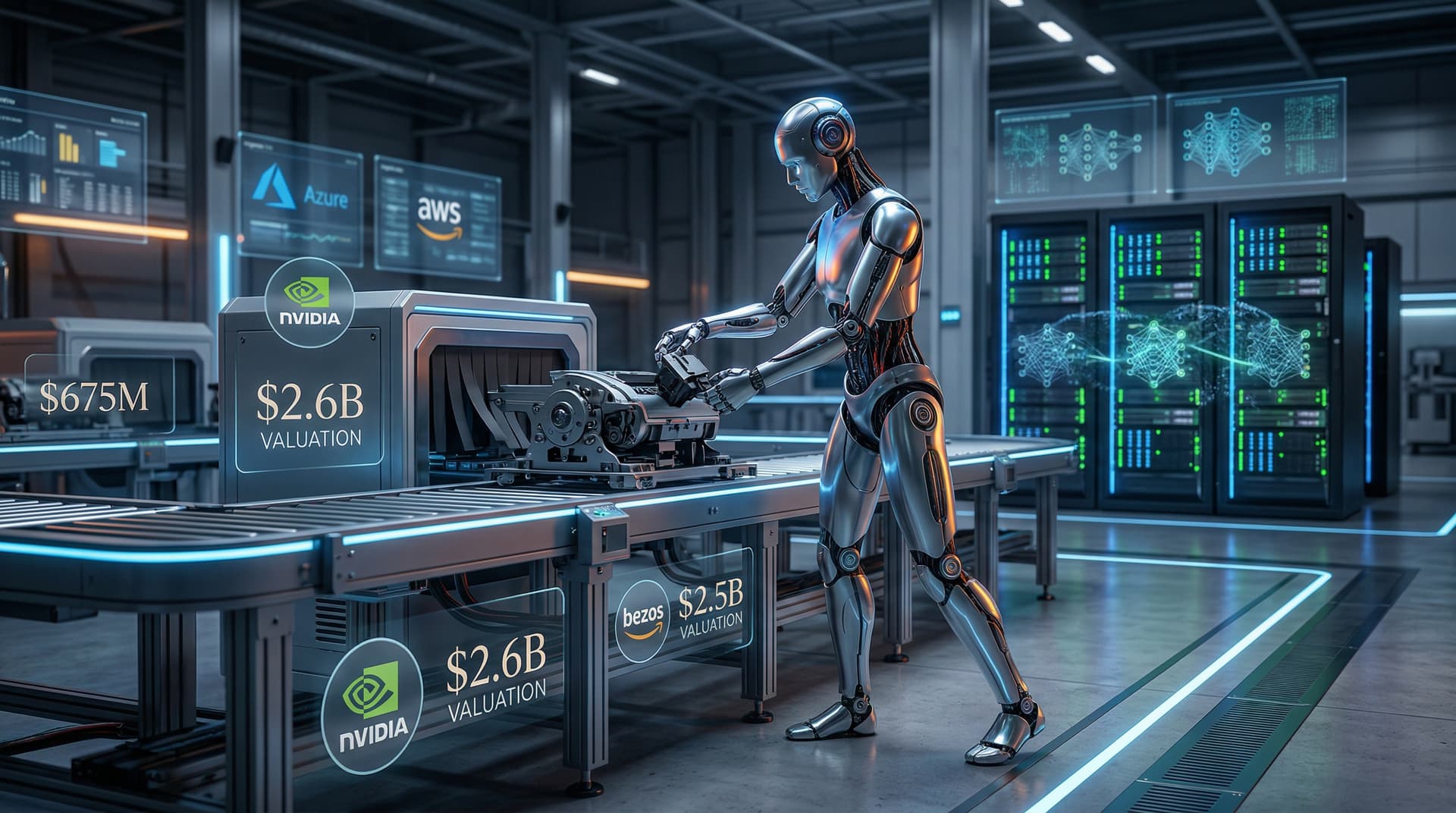
In a landmark deal for the AI robotics space, startup Figure AI closed a whopping $675 million Series B funding round on December 13, 2024. The infusion pushes the company's post-money valuation to $2.6 billion, cementing its position as a frontrunner in developing general-purpose humanoid robots. Led by existing investor Jeff Bezos via Bezos Expeditions, the round also drew commitments from Microsoft, Nvidia, Amazon Industrial Innovation, Intel Capital, Align Ventures, and ARK Invest.
The Rise of Figure AI
Founded in 2022 by Brett Adcock, Figure AI has quickly emerged from the pack of robotics startups. Unlike niche players focused on specific tasks like warehouse picking or delivery, Figure aims for versatile, human-like robots capable of handling a broad spectrum of jobs in manufacturing, logistics, healthcare, and home services. Their flagship robot, Figure 01, demonstrated impressive feats earlier this year, including autonomous coffee brewing and complex object manipulation powered by advanced AI vision and language models.
What sets Figure apart is its heavy reliance on end-to-end AI training, eschewing traditional hardcoded robotics programming. This approach mirrors breakthroughs in generative AI, where massive datasets and compute power yield emergent capabilities. Figure 01 integrates multimodal AI, processing vision, language, and sensor data to reason and act in unstructured environments—much like large language models (LLMs) but embodied in hardware.
Funding Breakdown and Strategic Investors
The $675 million round builds on Figure's prior $70 million seed (2023) and $510 million Series A (early 2024), bringing total funding to over $1.2 billion. Key investors bring more than cash:
- Nvidia: Provides cutting-edge GPUs like the GB200 Grace Blackwell Superchips for training Figure's AI models. This partnership underscores surging demand for high-performance computing (HPC) hardware in startups.
- Microsoft: Likely integrates Azure cloud for scaling AI workloads, aligning with their push into embodied AI.
- Amazon: Ties into AWS robotics services and potential deployment in fulfillment centers.
- Intel Capital: Bolsters hardware optimization for edge computing in robots.
"This funding accelerates our path to commercial deployment," said CEO Brett Adcock in a statement. "We're training the next generation of AI models on unprecedented compute clusters to unlock humanoid robots that work alongside humans."
Tech Stack: PC Hardware and Software at the Core
At PC News Digest, we see Figure's progress as a bellwether for PC hardware and software ecosystems. Humanoid robotics demands enormous compute:
- Training Phase: Figure leverages NVIDIA's latest DGX systems with H100 and upcoming Blackwell GPUs. A single training run for their vision-language-action (VLA) models requires thousands of GPUs, driving shortages and price premiums in the AI accelerator market.
- Inference on Device: Robots run optimized models on embedded NVIDIA Jetson Orin modules, pushing boundaries for low-power, high-efficiency AI chips.
- Software Ecosystem: Figure's stack includes custom RL (reinforcement learning) frameworks built on PyTorch, integrated with ROS2 for robotics middleware. They use vision transformers (ViTs) fine-tuned on proprietary datasets from BMW and other pilots.
This creates ripple effects:
- Hardware Demand: Expect sustained pressure on GPU supply chains, benefiting PC builders and IT admins provisioning AI clusters.
- Software Tools: Boom in open-source robotics libs like Isaac Sim from NVIDIA, aiding startups in simulation-to-real transfer.
- IT Infrastructure: Data centers will see hybrid setups blending NVIDIA HGX with Intel Xeon for cost-effective scaling.
| Component | Role in Figure 01 | Hardware Tie-In |
|---|---|---|
| Vision System | 6 RGB cameras + depth sensors | NVIDIA Jetson edge AI |
| Compute | VLA model inference | Blackwell GPUs |
| Actuators | 41 degrees of freedom | Custom servo motors w/ encoders |
| Software | End-to-end RLHF | PyTorch + custom datasets |
Partnerships and Real-World Deployment
Figure isn't just lab-bound. A pilot with BMW began in 2024 at their Spartanburg plant, where Figure 01 autonomously inserts sheet metal parts— a task requiring dexterity and adaptation. This validates the tech for IT-heavy industries like automotive manufacturing.
Upcoming: Expanded pilots with logistics giants, leveraging Amazon's know-how. By 2025, Figure targets low-volume production, selling robots at $30,000-$50,000/unit, undercutting Tesla's Optimus ambitions.
Broader Implications for Startups and Tech Landscape
This funding arrives amid a frothy AI investment climate. December 2024 has seen a flurry of robotics raises: Physical Intelligence ($400M on Dec 4), 1X ($100M+), and others. Yet Figure's haul dwarfs most, signaling investor confidence in 'embodied intelligence'—AI that acts in the physical world.
For PC hardware:
- GPU Market: NVIDIA's data center revenue hit records; startups like Figure amplify this, potentially spilling into consumer PC upgrades for AI dev.
- Edge Computing: Rise of compact AI PCs (e.g., Snapdragon X Elite, Intel Lunar Lake) could inspire robot-inspired mini-clusters.
Software side: Tools like Figure's open-sourced elements foster an ecosystem. Startups can now access pre-trained VLAs via Hugging Face, lowering barriers.
Challenges remain: Safety (ASIL-D compliance), energy efficiency (batteries last 5 hours), and ethics (job displacement). Regulators eye AI robots closely post-EU AI Act.
Future Outlook
With $675M war chest, Figure eyes a 2025 factory ramp-up. Adcock hints at Figure 02: taller, stronger, with 10x dexterous hands and native tool use. Integration with LLMs like GPT-5 or Claude 3.5 could enable conversational tasking: "Fold these shirts neatly."
In the startups arena, Figure exemplifies the PC-IT convergence: massive cloud training meets edge deployment, all fueled by hardware innovators. As humanoid robots enter warehouses and homes, expect IT pros to manage fleets via Kubernetes-orchestrated ROS clusters.
This round isn't just cash—it's a vote for AI's physical future, where software dreams meet hardware reality. PC News Digest will track Figure's milestones closely.
Word count: 912