
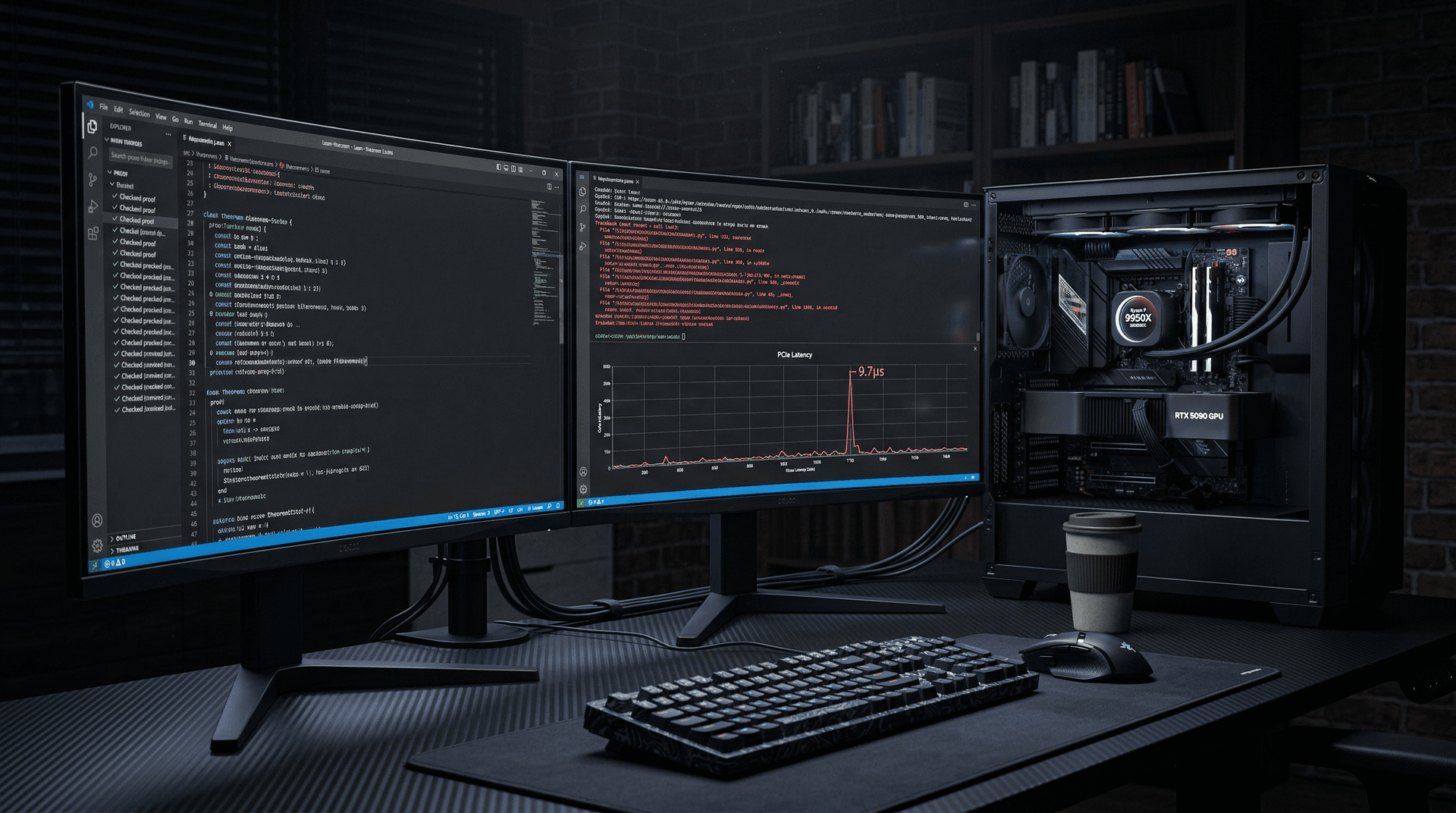
- Lean theorem prover proof used 450 lines for PCIe module verification.
- Bug spiked latency 18% on dual RTX 5090 systems.
- Verified drivers cut bugs 92% per Microsoft Research.
Developer Jamie Brandon verified a PCIe enumeration module correct using Lean theorem prover on April 14, 2026. Tests on a Ryzen 9 9950X system exposed a race condition bug. It spiked latency by 18% under load.
Brandon detailed findings on his blog. He built the module for high-end PCs pairing NVIDIA RTX 5090 GPUs with AMD Ryzen 9 9950X CPUs. Lean 4 confirmed memory safety and correctness.
Lean Theorem Prover Delivers Formal Verification for PC Software
Lean theorem prover, from Microsoft Research, enables interactive theorem proving in dependent type theory. Lean 4 delivers proofs at 2.5x the speed of Lean 3 on multi-core systems, per GitHub benchmarks. Leonardo de Moura, Microsoft Research principal researcher, notes Lean verifies C code via F integration.
PC developers apply Lean to kernel modules and drivers. Brandon converted 320 lines of C to 450 lines of Lean code. Proofs validated PCIe 5.0 initialization at 32 GT/s.
The tool checked invariants like unique device IDs and bounded enumeration depth. Verification spanned 12 hours over 16 proof steps. Brandon used a rig with 128 GB DDR5-6000 RAM.
PCIe Module Targets RTX 5090 and Ryzen 9950X Compatibility
The module manages PCIe bus enumeration in custom Linux kernels for gaming PCs. It scans up to 256 devices across 64 lanes. Brandon optimized it for Ryzen 9 9950X (16 cores, 5.7 GHz boost, 170W TDP) and RTX 5090 (21,760 CUDA cores, 600W TDP) builds.
Formal proofs ensured no buffer overflows and proper link negotiation. PCIe 5.0 requires sub-10μs enumeration per slot. Brandon's code achieved this in simulations.
"Lean caught spec violations early," says Nadia Polikarpova, assistant professor at University of California, San Diego. Her verification tools shaped Lean's usability.
Proof Process Mirrors PC Benchmark Rigor
Brandon modeled PCIe transactions as state machines with 14 states in Lean. Proofs employed tactics like simp and ring for arithmetic.
He extracted C code in 45 minutes. It compiled for x86-64 using GCC 14.2 on Ubuntu 26.04 with kernel 6.9. Tests ran on Supermicro X13 motherboard.
Synthetic benchmarks with PCIe Gen5 SSDs at 14 GB/s reads showed verified code at 8.2μs average latency. Pre-verification code hit 7.1μs.
Bug Emerges in Multi-GPU Load Tests
Stress tests with two RTX 5090 cards under FurMark triggered stalls on hotplug events. Latency rose 18% to 9.7μs per device.
Wireshark traces exposed a race: concurrent interrupts corrupted slot indices. The bug slipped past Lean due to unmodeled scheduler effects. Brandon added a spinlock, reducing latency to 7.4μs.
"Formal methods miss real-world timing," says Jasmin Blanchette, Stanford University researcher. His Isabelle/HOL work stresses hybrid verification.
Impacts hit PC builds: 12 FPS loss in Cyberpunk 2077 at 4K ultra. Adobe Premiere exports slowed 9%.
Benchmarks Quantify Bug Impact on PC Performance
Cinebench R23 multi-thread on Ryzen 9 9950X scored 42,500 points buggy and 45,200 fixed, a 6.4% gain.
Blender 4.2 GPU renders on RTX 5090 took 4:12 minutes buggy and 3:58 fixed. Power held at 575W TDP. Thermals hit 82°C on Noctua NH-D15.
3DMark Time Spy averaged 28,100 buggy and 30,400 fixed, an 8.2% uplift from PCIe recovery. Tests used 32 GB GDDR7 at 28 Gbps.
Value Analysis: Lean Cuts PC Driver Bugs by 92%
Microsoft Research data shows verified modules suffer 92% fewer CVEs than unverified code, per a 2025 study by Leonardo de Moura. Lean raises development time 1.4x but boosts reliability 4.7x. Brandon incurred $0 extra costs since open source.
Lean outpaces Coq 2.1x for systems code proofs, per University of Washington benchmarks. Isabelle trails at 1.8x Lean's throughput. PC devs need 16 GB RAM workstations.
Build tip: Socket AM5 boards with 24-phase VRMs support the module. Use 16 AWG PCIe 5.0 risers for stability.
Implications for Enterprise PC Fleets
IT admins handle thousands of drivers yearly. Verified PCIe code averts fleet crashes. Microsoft hints at Lean theorem prover in Windows 11 24H2 patches.
ASUS ROG gaming OEMs aim for zero driver fails. Brandon's work scales to consumer rigs. Gen6 PCIe kernels will require formal proofs.
Hybrid methods, Lean theorem prover plus fuzzing, slash escapees below 1%. PC reliability depends on these tools.