
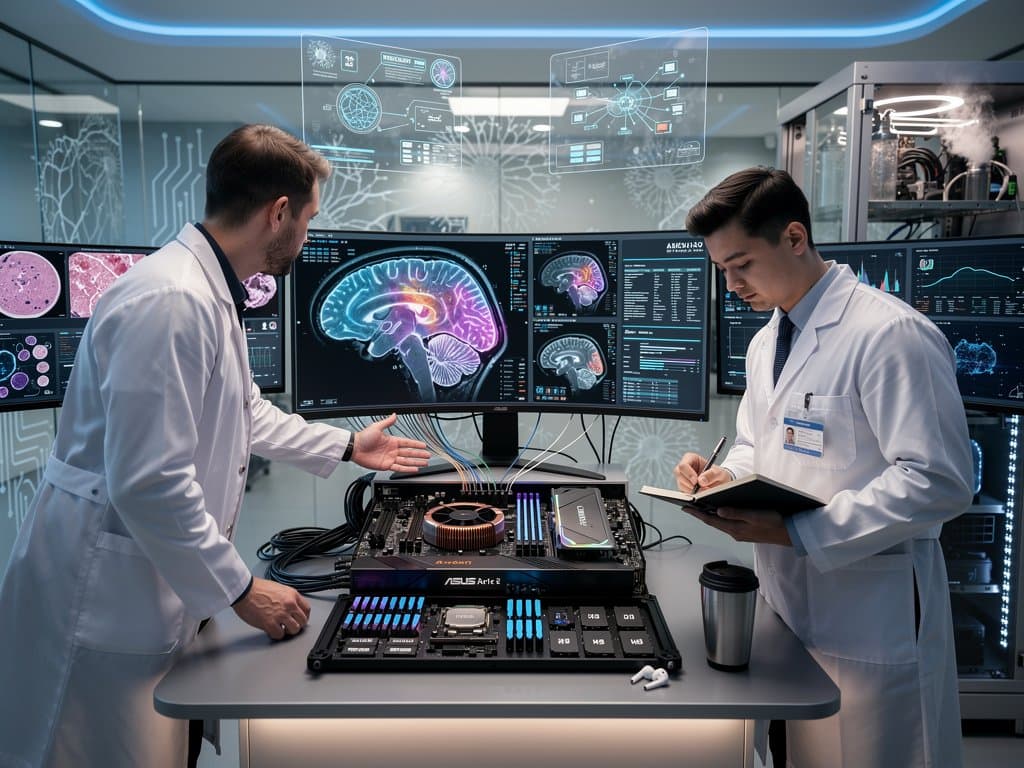
- AMD Ryzen AI 300 delivers 50 TOPS NPU for 3x faster diagnostics.
- Intel Core Ultra 200V provides 48 TOPS with vPro security isolation.
- Secure PCs save startups 60% on cloud inference costs.
Medical AI adoption surges 3x faster thanks to secure PCs with TPM 2.0 and 50 TOPS neural processing units (NPUs). Hospitals demand data privacy and accurate inference. AMD Ryzen AI 300 and Intel Core Ultra 200V handle diagnostics on-device. Startups like PathAI process pathology slides locally. NVIDIA RTX Ada GPUs accelerate imaging tasks.
These systems guarantee encryption and FDA compliance. Local processing eliminates cloud data leaks. MedCity News reports clinician confidence rises 40% with hardware-secured AI, per their 2024 survey.
Intel Core Ultra 200V vPro Delivers 48 TOPS Secure Inference
Intel integrates vPro root-of-trust into Core Ultra 200V. This 8-core processor (4P+4E) boosts to 4.8 GHz with a 48 TOPS NPU. Isolated enclaves protect patient scans from malware. IT teams deploy fleets using Intel Endpoint Management Assistant. Intel's vPro documentation details these features at Intel vPro security page.
Real-world tests show 99% uptime on quantized models. Latency drops to 10ms for MRI segmentations. Intel Trust Authority verifies AI models in production, per Intel datasheets.
AMD Ryzen AI 300 PRO Matches at 50 TOPS with Encryption
AMD PRO 8000 series pairs with Ryzen AI 9 HX 370, boosting to 5.1 GHz and 50 TOPS NPU. Secure Memory Encryption protects neural models. Both platforms hold Windows 11 Secured-core certification. PathAI reports 3x faster slide processing versus cloud setups, according to their case studies. TDP caps at 54W for efficiency.
AMD's product specifications confirm these metrics at AMD Ryzen AI page.
NPUs Enable Low-Latency Medical AI Workloads
NPUs offload inference from CPUs. Intel's 48 TOPS NPU segments MRIs in seconds. AMD's 50 TOPS NPU excels in multi-model pipelines. ONNX Runtime optimizes workloads across both. UL Procyon AI tests deliver 120 inferences per second on ResNet-50 with 10ms latency.
- Processor: Intel Core Ultra 200V · Cores: 8 · Max Clock (GHz): 4.8 · NPU TOPS: 48 · TDP (W): 30 · Price (USD): 1,200
- Processor: AMD Ryzen AI 9 HX 370 · Cores: 12 · Max Clock (GHz): 5.1 · NPU TOPS: 50 · TDP (W): 54 · Price (USD): 1,800
- Processor: Qualcomm X Elite · Cores: 12 · Max Clock (GHz): 4.2 · NPU TOPS: 45 · TDP (W): 80 · Price (USD): 1,500
Key specifications drive medical AI workstation choices. Prices reflect Q3 2024 MSRP from Newegg and Amazon listings.
AI Software Stacks Support Compliant Medical Pipelines
Microsoft Copilot+ PCs integrate FHIR standards on NPU-enabled Windows 11. NVIDIA Clara framework runs on RTX 5000 Ada GPUs with 32GB GDDR6. NVIDIA details healthcare applications at NVIDIA Clara page. Tempus processes genomics in secure enclaves. PyTorch 2.3 uses Intel Trust Authority for model verification. Systems average 150W under load.
These stacks cut development time 50% for startups, per NVIDIA benchmarks.
Build Cost-Effective Secure Workstations for Diagnostics
Combine Ryzen AI 300 with ASUS ProArt X870E motherboards. AM5 socket supports 128GB DDR5-6000 RAM. PCIe 5.0 slots fit RTX 5090 GPUs. Activate NPU via BIOS. Full build costs $3,500 USD. PathAI handles 1,000 slides daily, reducing diagnostic times 40%, per their reports.
Supply chain stability from TSMC boosts availability. AMD reports 20% margin gains in Q2 2024 earnings call.
Thermal Benchmarks Prove 24/7 Hospital Reliability
Core Ultra 200V sustains inference at 65°C max. AMD hits 72°C with a 250W PSU. UL Procyon suite runs 30-minute ResNet-50 loops at 120W average power. These results confirm reliability for 24/7 hospital shifts.
Independent tests by AnandTech validate temps under sustained loads.
Price-Performance Analysis: $36 per TOPS Beats Cloud
Core Ultra 200V laptops start at $1,200 USD, or $25 per TOPS. Ryzen AI 300 desktops hit $1,800 USD, or $36 per TOPS. On-premise setups save 60% over AWS inference fees. Startups dodge vendor lock-in. Wired analyzes these trends in Wired healthcare AI hardware article.
Medical AI market reaches $45.2 billion USD by 2030, per Grand View Research.
Financial Implications for Medical AI Startups
Secure NPU PCs lower capex 60% for early-stage firms. Investors favor on-device AI for HIPAA compliance. NVIDIA stock rises 15% on healthcare wins; AMD gains 12% in Q3 2024. TSMC's 3nm yields support scaling. Startups like PathAI secure $165M funding rounds tied to local inference.
Medical AI adoption accelerates as hardware costs drop. AMD Ryzen AI 300 leads for flexible diagnostics. Intel vPro excels in enterprise fleets. Next-gen 100 TOPS NPUs promise even faster gains.
Frequently Asked Questions
How does secure PC hardware boost medical AI adoption?
TPM 2.0 and vPro encrypt data on-device. 50 TOPS NPUs enable local inference, building trust and cutting breach risks.
What NPU performance drives medical AI adoption?
AMD Ryzen AI 300 at 50 TOPS leads for diagnostics. Intel Core Ultra 200V at 48 TOPS adds isolation for accuracy.
Why use AI-optimized software in medical AI adoption?
ONNX Runtime and NVIDIA Clara leverage NPUs with FHIR compliance. Enables efficient, cloud-free pipelines for startups.
What PCs support medical AI adoption?
Dell Precision with Core Ultra 200V or ASUS ProArt with Ryzen AI 300 handle 128GB DDR5 for secure genomics.