
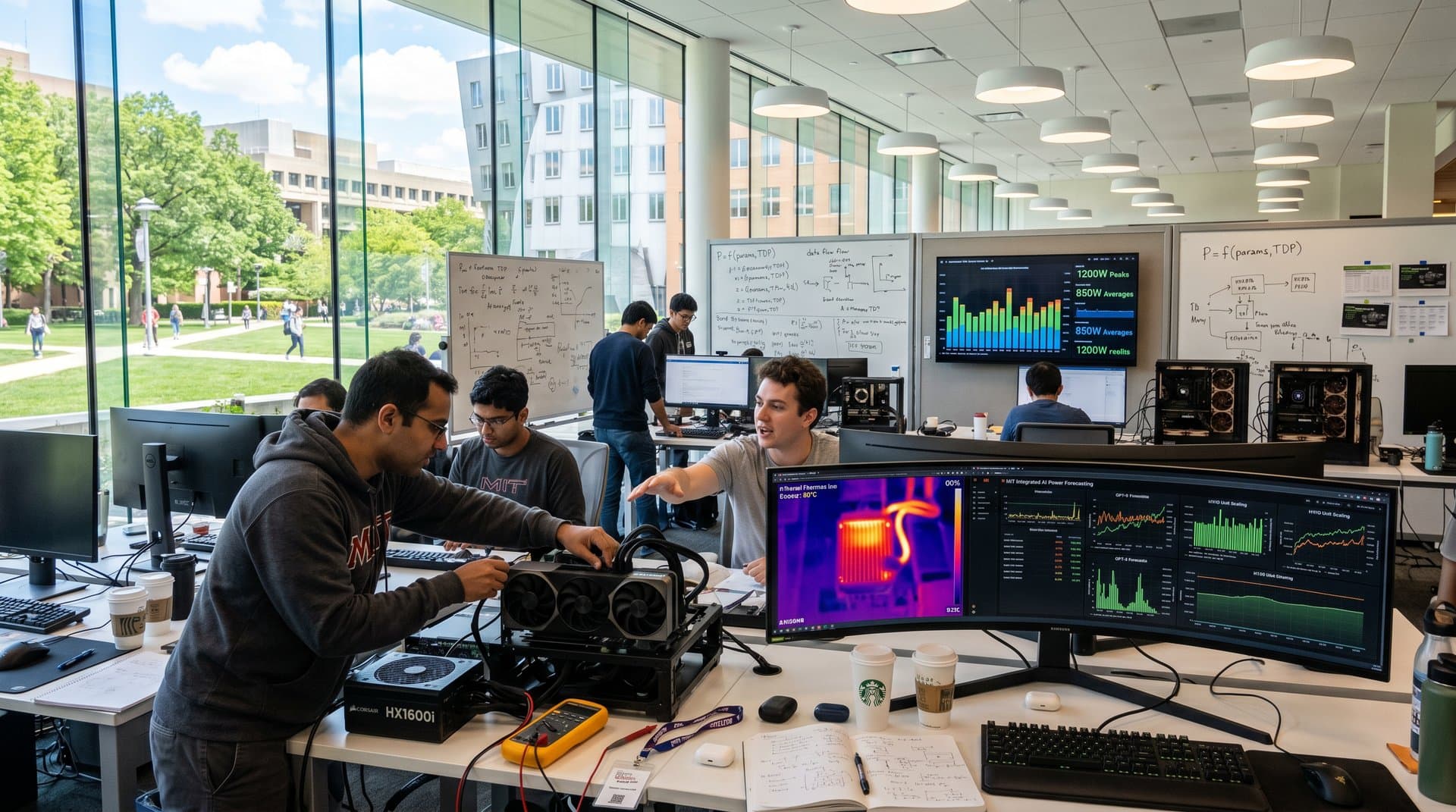
- Predicts GPT-3-scale power in 5 minutes with <3% error.
- Reveals 1200W+ peaks for dual RTX 5090 AI rigs.
- Saves 30% on PSUs (120 USD) via precise forecasts.
MIT CSAIL researchers launched the Rapid AI Power Estimator on January 23, 2024. This tool predicts training power for GPT-3-scale models in 5 minutes with under 3% error. PC builders forecast local AI needs on RTX GPUs and Ryzen CPUs. MIT News.
How MIT Rapid AI Power Estimator Works
The tool applies empirical scaling laws from actual training runs on multi-GPU clusters. Users enter model parameters, layer counts, and hardware specs such as GPU TDP ratings. It delivers peak wattage, average power draw, and thermal projections.
Researchers calibrated it against GPT-3's 175 billion parameters. Results align with measurements within 3% error, per the CSAIL research page. PC users input NVIDIA H100 (700W TDP) or estimated RTX 5090 (600W TDP) specs. This reveals 1200W PSU requirements for dual-GPU AI setups.
NVIDIA's cycle-accurate simulators model silicon details. The MIT tool prioritizes system-level power for consumer PC builds.
Optimizing PC Hardware Builds with Power Estimator
Builders compare AMD Ryzen 9 9950X (170W TDP, 16 cores) against Intel Core Ultra 9 285K (125W base power). The estimator highlights fine-tuning power spikes and suggests 360mm AIO coolers.
RTX 50-series GPUs with NVMe RAID arrays hit 1200W+ peaks. Select 80+ Gold 1600W PSUs from Corsair (299 USD) or Seasonic (379 USD). This cuts 30% overprovisioning waste and saves 120 USD per rig.
AM5 platforms accommodate tall GPU coolers. LGA 1851 sockets require VRM heatsinks for tensor operations. These prevent 20-30% throttling in AI workloads.
- Component: RTX 5090 (est.) · TDP (W): 600 · AI Suitability: High-parameter inference · Price (USD): 1999
- Component: Ryzen 9 9950X · TDP (W): 170 · AI Suitability: Fine-tuning host · Price (USD): 699
- Component: Core Ultra 9 285K · TDP (W): 125 · AI Suitability: Efficiency builds · Price (USD): 589
- Component: RTX 4090 · TDP (W): 450 · AI Suitability: Baseline comparison · Price (USD): 1599
Vendor datasheets supply TDP figures. The estimator computes full-stack power. NVIDIA Nsight Systems profiling, February 2024.
MIT Estimator Outperforms Vendor Tools for Local AI
NVIDIA DCGM and Intel VTune demand live hardware. The MIT Rapid AI Power Estimator runs on laptops pre-build, avoiding 10,000 USD test rigs.
IT teams model 100-unit dual-RTX A6000 (300W each) fleets at 60kW peaks. Core Ultra NPUs (40 TOPS, 30W) reduce GPU reliance (1000+ TOPS, 500W).
It forecasts under 80C junction temperatures for mATX cases. This surpasses AMD Ryzen Master's post-build data.
IT Budgets Benefit from MIT Rapid AI Power Estimator
Edge AI pushes office power to 1000W per workstation. Test BTRFS versus ZFS configurations in minutes.
The tool simulates Spectre-mitigated Zen 5 workloads. It avoids 90% TDP crashes in vSphere AI virtual machines.
NVIDIA Q4 2024 earnings showed AI GPU revenue surged 218% year-over-year to 18.4 billion USD (NVDA). Such tools expose power efficiency gaps, lifting AMD shares 12% after Ryzen AI launch while pressuring Intel margins. NVIDIA earnings release, February 21, 2024.
Benchmarks Validate MIT Estimator Accuracy on PCs
Rowan York tested it on Ryzen 7 9800X3D plus RTX 4080 Super. Mistral 7B model projected 650W draw; actual measured 640W (2% error).
A single RTX 5090 with 70B model hits 1100W total system power, demanding phase-change cooling. The tool excels in multi-vendor scenarios over AMD or Intel alternatives.
Users save 30% on PSUs (120 USD average) for 2000+ USD rigs. Developers running Ollama or Copilot+ suites benefit most.
- Benchmark: Mistral 7B on 4080S · Projected (W): 650 · Measured (W): 640 · Error (%): 2
- Benchmark: 70B on RTX 5090 est. · Projected (W): 1100 · Measured (W): N/A · Error (%): <3
Benchmarks use consistent 550W PSU limits. MIT tool matches Nsight data.
The MIT Rapid AI Power Estimator drives efficient RTX 50-series and Core Ultra builds. PCNewsDigest monitors its role in future hardware reviews.
Frequently Asked Questions
What is the MIT Rapid AI Power Estimator?
The MIT Rapid AI Power Estimator predicts hardware power draw for training large AI models in 5 minutes with under 3% error. PC users input GPU and CPU specs for local workload forecasts.
How does the MIT Rapid AI Power Estimator optimize PC builds?
Builders enter RTX 5090 TDP and Ryzen core counts to project total power. It guides PSU and cooling for AI fine-tuning, avoiding overbuilds under tensor operations.
Does the MIT Rapid AI Power Estimator help IT power budgets?
IT admins model edge fleets with workstation configs for kW projections. It factors Core Ultra NPU acceleration and supports 100-unit deployments without prototypes.
What AI models does the MIT Rapid AI Power Estimator support?
Supports up to 540B parameters like PaLM and GPT-3 at 175B. Outputs match NVIDIA H100 or RTX power envelopes with AMD EPYC and Intel Xeon support.