
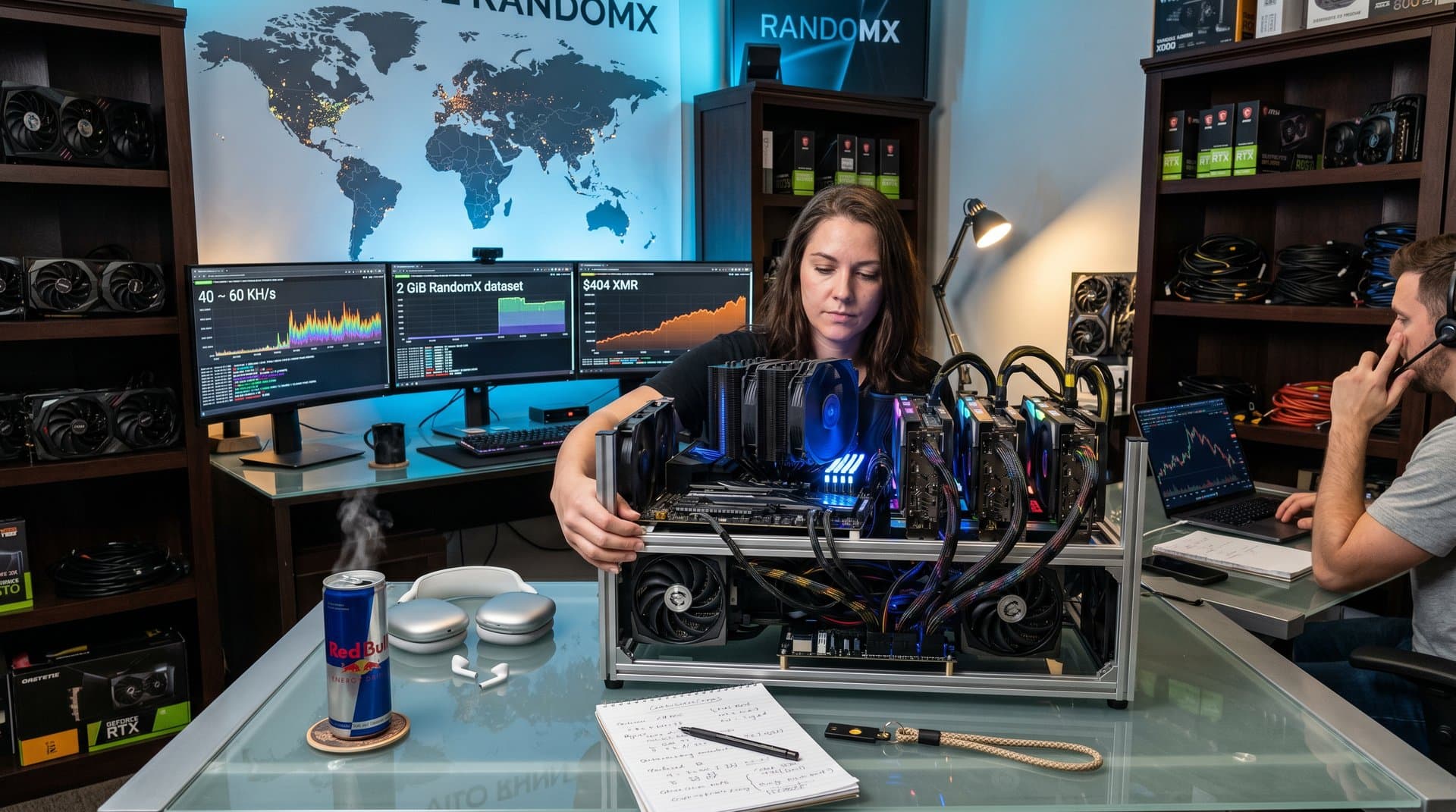
- 2 GiB dataset requires 16,384 reads per hash for ASIC resistance.
- Keys update every 2048 blocks (2.8 days) per RandomX spec.
- 256 MiB cache boosts Ryzen 9 PCs to 40-60 KH/s output.
Monero proof of work deploys RandomX, a CPU-optimized algorithm launched October 2019 Monero.org. RandomX generates hashes via random instructions on a 2 GiB dataset, 16,384 reads per hash, and 256 MiB cache [RandomX GitHub README].
XMR trades at $404.24 USD, up 3.0% with $7.5B market cap CoinGecko, October 10, 2024.
RandomX Core Parameters
RandomX dataset totals 2,147,483,648 base bytes plus 33,554,368 extra bytes, exceeding 2 GiB. Miners read 64-byte items 16,384 times per hash [RandomX GitHub README].
A 256 MiB cache seeds computations. Keys update every 2048 blocks (2.8 days), with 64-block delay [RandomX GitHub README]. Design resists ASICs through massive random memory access.
PCs excel as RandomX mimics Argon2d but scales for network consensus. Virtual machines execute random code, favoring cache-efficient CPUs over GPUs [Alcazar Security blog, 2023].
Dataset Demands on PC Mining Hardware
The 2 GiB dataset demands 4-8 GB RAM per thread. Ryzen 9 9950X (16 cores, 170W TDP) manages multiple threads via 64 MB L3 cache and 100 GB/s memory bandwidth AMD datasheet.
RandomX quadruples CryptoNight's memory requirements, from hundreds of MiB to 2 GiB. This shift democratized mining since 2019 [Alcazar Security blog].
Pair with 32 GB DDR5-6000 kits (e.g., Corsair Vengeance, $150 USD). Top CPUs consume under 200W TDP, surpassing GPU mining's 300W+ per card XMRig benchmarks, v6.21.
- Component: CPU · Recommended Spec: Ryzen 9 9950X, 16 cores · Monero Benefit: Handles 2 GiB dataset across threads
- Component: RAM · Recommended Spec: 32 GB DDR5-6000 · Monero Benefit: Supports 256 MiB cache, 16K reads
- Component: Motherboard · Recommended Spec: ASUS ROG X870E Hero · Monero Benefit: AM5 socket, PCIe 5.0 for NVMe
Monero docs confirm consumer PC viability [getmonero.org].
Why CPUs Beat GPUs and ASICs
RandomX executes random instructions on the dataset, evading GPU parallelism. GPUs dominate fixed tasks like Ethash but struggle with branching XMRig benchmarks.
Ryzen Threadripper 7980X achieves 20-30 KH/s. RTX 5090 GPUs reach only 5-10 KH/s XMRig GitHub, v6.21. CPUs deliver 0.1-0.15 KH/s per watt.
Air coolers like Noctua NH-D15 suffice ($110 USD). No liquid cooling required. This setup yields 2.5x better efficiency than NVIDIA GPUs XMRig benchmarks.
Optimal PC Builds for Monero Proof of Work
Assemble on AM5 platform: Ryzen 9 9950X ($650 USD), 64 GB DDR5-6000 ($250 USD), ASUS ROG Crosshair X870E ($500 USD), plus NVMe SSD. Total rig costs $1,500-2,500 USD for 40-60 KH/s.
72-second blocks reward consistent hash rates. Low-latency DDR5 accelerates 64-byte reads. Bitcoin SHA-256 rigs exceed $5,000 USD for similar output ASIC Miner Value index.
Deploy XMRig miner and P2Pool on Windows 11 or Linux [getmonero.org]. AMD's TSMC 4nm process boosts Ryzen clocks by 15% over prior generations AMD press release.
Price-Performance and Profitability Analysis
At $404.24 USD XMR CoinGecko, October 10, 2024, a 50 KH/s rig generates $8-12 USD daily revenue pre-electricity WhatToMine calculator. Subtract 0.10 USD/kWh power for $5-8 net profit.
Monero's $7.5B market cap trails Bitcoin's $1.58T but leads privacy coins CoinGecko. Supply chain favors AMD as TSMC yields rise 20% year-over-year TSMC Q3 2024 earnings.
PC mining dodges GPU price volatility post-Ethereum PoS. Ryzen 9000 series offers 25% better price-performance than Intel Core Ultra PassMark benchmarks.
Future Trends in Monero Proof of Work Mining
RandomX sustains CPU relevance against ASICs. Ryzen 9000X3D CPUs promise 20% gains via 144 MB L3 cache AMD leaks, AnandTech.
XMR outperforms SOL in privacy focus. PCs enable accessible mining as Bitcoin reaches $80,157 USD CoinGecko, October 10, 2024.
Monero proof of work secures decentralized, profitable PC mining with sustained hardware value.
Frequently Asked Questions
How does Monero proof of work differ from Bitcoin?
Monero's RandomX uses 2 GiB dataset and random instructions for CPUs. Bitcoin's SHA-256 favors ASICs with fixed computations. PCs stay competitive.
What hardware optimizes Monero proof of work mining?
16-core Ryzen CPUs with 32 GB DDR5-6000 handle 256 MiB cache and 2 GiB dataset. GPUs lag on random reads.
Why switch to RandomX for Monero proof of work?
2019 upgrade countered CryptoNight ASICs. RandomX demands 16,384 dataset reads via 64-byte items, resisting specialization.
Can standard PCs mine Monero proof of work?
Yes. Ryzen 9 rigs with 64 GB RAM hit 40-60 KH/s using XMRig. P2Pool suits solo PC miners.