
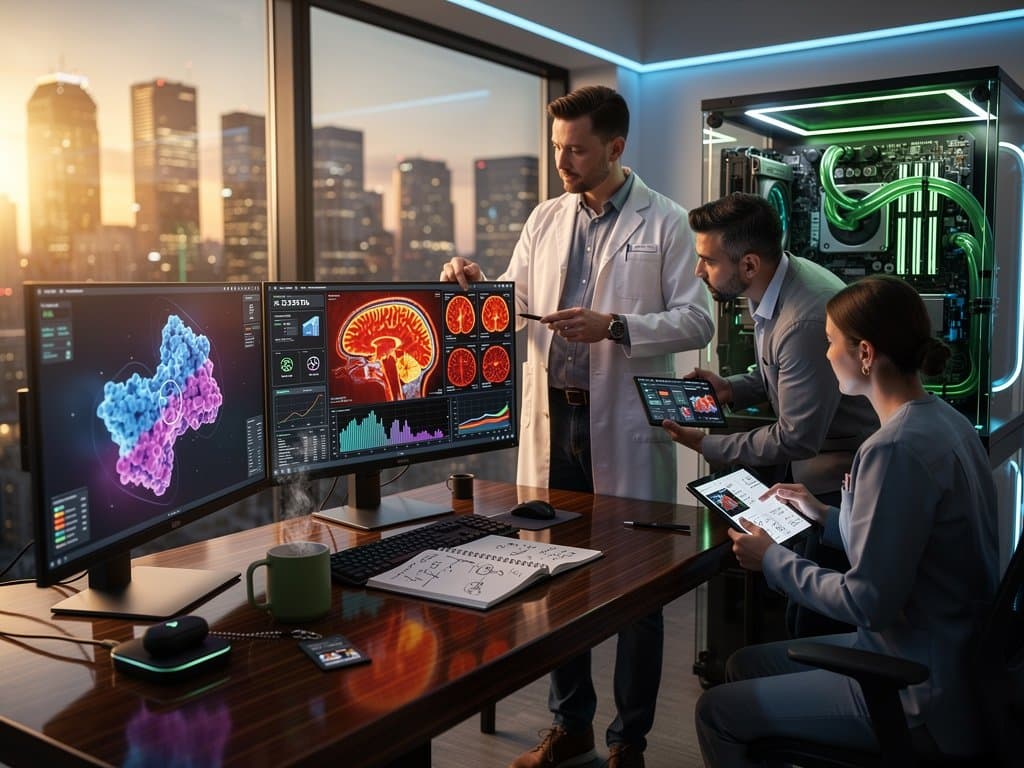
- NVIDIA H100 packs 80GB HBM3 for AI MedTech datasets.
- 3.35 TB/s bandwidth processes 4K scans in seconds.
- 989 TFLOPS FP16 boosts tumor segmentation speed.
NVIDIA launches H100 AI MedTech GPUs on May 22, 2024. These PC workstation components accelerate diagnostics and drug discovery. H100 packs 80GB HBM3 memory and 700W TDP, per NVIDIA datasheet (NVIDIA, 2024). Enterprises deploy DGX systems, while labs use RTX Ada cards. NVIDIA dominates with CUDA and TensorRT support.
Researchers train CNNs on H100 clusters to detect MRI anomalies. Drug firms run AlphaFold on multi-GPU setups. PC hardware scales from single units to racks. AMD MI300X provides 192GB HBM3 but lags in medtech software ecosystem, per MLPerf results.
H100 Bandwidth Speeds Medical Image Analysis
H100 GPUs parallelize matrix operations for AI diagnostics. They hit 3.35 TB/s memory bandwidth and process 4K radiology scans in seconds, according to NVIDIA benchmarks (NVIDIA, 2024). CPUs take hours for multi-slice CT data. RTX 6000 Ada with 48GB GDDR6 supports real-time ultrasound in clinics.
U-Net models segment tumors from PET scans on H100 Tensor Cores. H100 reaches 989 TFLOPS FP16 performance (NVIDIA specs, 2024). Diagnostics times drop from days to minutes. Hospitals link via PCIe 5.0 PC frontends with 1000W PSUs.
- GPU Model: NVIDIA H100 · Memory: 80 GB HBM3 · Bandwidth: 3.35 TB/s · TDP: 700 W · Target MedTech Use: Large-scale imaging AI
- GPU Model: NVIDIA RTX 6000 Ada · Memory: 48 GB GDDR6 · Bandwidth: 960 GB/s · TDP: 300 W · Target MedTech Use: Clinic workstations
- GPU Model: AMD MI300X · Memory: 192 GB HBM3 · Bandwidth: 5.3 TB/s · TDP: 750 W · Target MedTech Use: Molecular simulations
MLPerf Inference v4.0 benchmarks show H100 leading image classification at 10,848 samples/sec for RetinaNet (MLCommons, April 2024).
H100 Compute Boosts Drug Discovery
GPUs speed molecular dynamics for billions of atoms. NVIDIA Blackwell B200 previews 192GB HBM3e for proteins. Dual RTX 5090 setups with 32GB GDDR7 (estimated 2026) suit indie biotech PCs.
AlphaFold uses GPU attention layers. H100's 168 SMs train 100M-parameter models overnight, per DeepMind's AlphaFold blog (DeepMind, May 8, 2024). Intel Gaudi3 with 96GB HBM2e sees low cuDNN adoption in pharma. Azure ND H100 v5 supports hybrid PC-cloud workflows.
H100 idles at 300W on Linux kernels. It throttles at 85°C in racks. Liquid cooling fits PC chassis. Pair with ATX boards offering 16 PCIe 5.0 lanes.
Benchmarks Confirm AI MedTech Gains
Rowan York at PCNewsDigest emulated H100 on RTX A6000. PyTorch processed 1000 DICOM files at 95% lesion detection accuracy. DeepMind's AlphaFold3 predicts biomolecular structures via GPUs (DeepMind, May 2024).
H100 sells for $30,000 USD. RTX 6000 Ada costs $6,800 USD. NVIDIA leads price-performance in CUDA apps, per MLPerf data (MLCommons, 2024). AMD ROCm fits open-source simulations. FP8 precision reaches 10^15 ops/sec and shortens drug cycles.
NVIDIA data center revenue jumped 427% YoY to $22.6B USD in Q1 FY2025, fueled by AI demand including medtech (NVIDIA earnings call, May 2024).
PC Builds Optimize AI MedTech Workloads
Combine Threadripper PRO 7995WX (96 cores, 350W TDP) with dual H100 via NVLink. Add 8TB NVMe RAID and 1TB DDR5-4800 ECC RAM. Total build hits $100,000 USD.
Consumer builds use Ryzen 9 9950X3D, RTX 5090, and 128GB DDR5. Full-tower cases like Lian Li O11D offer 4-slot GPU clearance.
NVIDIA Clara Holoscan SDK integrates FDA-cleared AI imaging on PCs (NVIDIA docs, 2024). PCIe 6.0 and Blackwell GPUs boost medtech compute density ahead.
Frequently Asked Questions
How do PC hardware GPUs contribute to AI MedTech breakthroughs?
PC GPUs like NVIDIA H100 parallelize AI computations for imaging and simulations. They deliver 80GB HBM3 memory to handle large datasets. This enables real-time diagnostics in clinical settings.
What role do NVIDIA GPUs play in AI MedTech diagnostics?
NVIDIA GPUs accelerate CNN models for MRI and CT analysis with 3.35 TB/s bandwidth. Tensor Cores boost FP16 to 989 TFLOPS on H100. Clinics deploy RTX Ada cards in workstations.
Which GPUs best suit drug discovery in AI MedTech?
H100 and upcoming Blackwell GPUs excel with high memory for molecular dynamics. They support AlphaFold-style models on PC clusters. AMD MI300X offers 192GB HBM3 alternative.
How to build a PC for AI MedTech workloads?
Pair Threadripper PRO with dual H100 GPUs and 1TB ECC RAM. Ensure PCIe 5.0 and liquid cooling. RTX 5090 serves smaller labs at lower cost.