
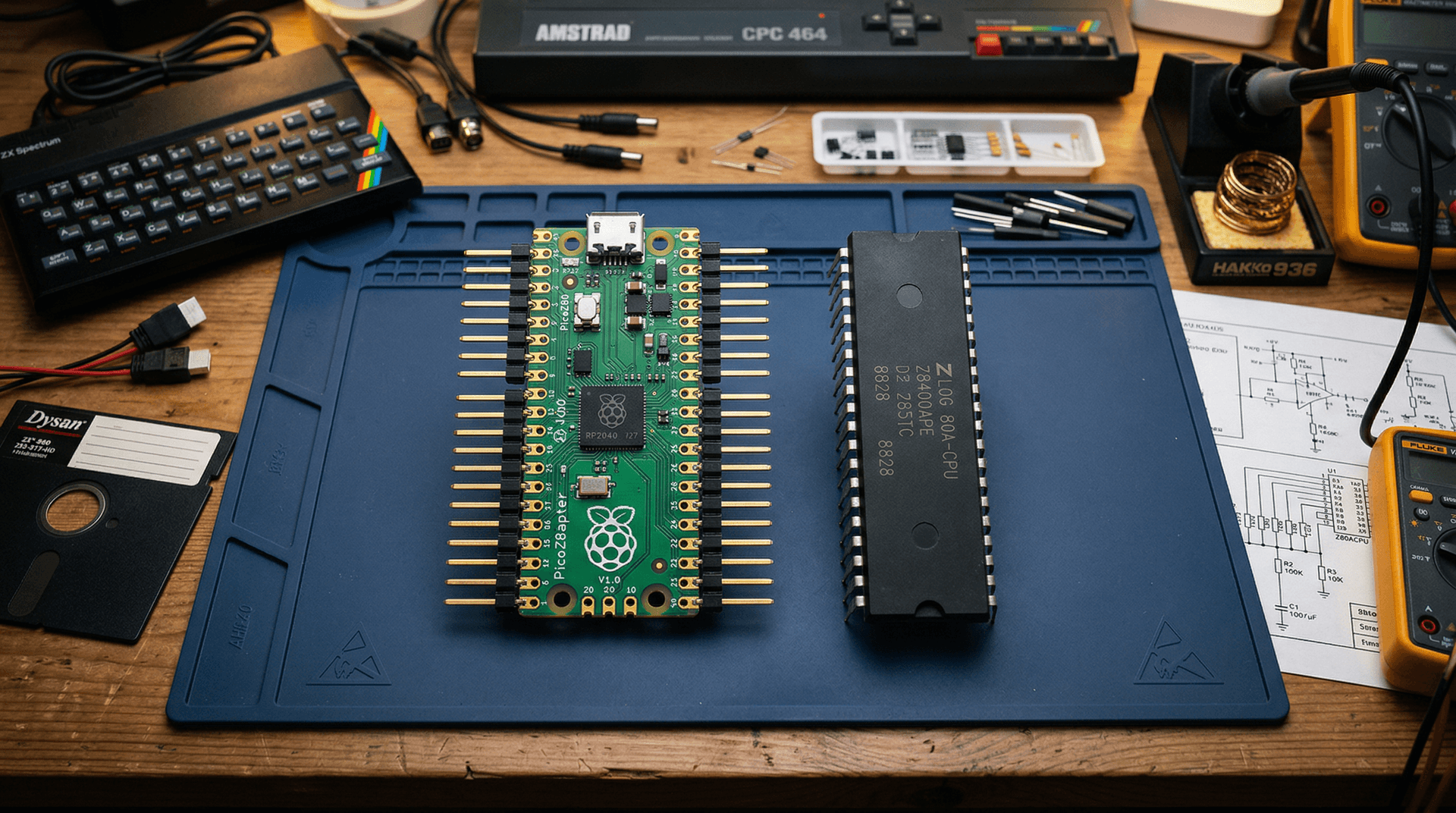
PicoZ80 launches April 10, 2026, as a drop-in Z80 CPU replacement. Developer John Lonergan built it using Raspberry Pi Pico's RP2040 chip. Retro PC enthusiasts gain up to 10x performance while retaining full Z80 compatibility.
The module slots into standard 40-pin Z80 sockets. It emulates the full Z80 instruction set via RP2040 PIO engines. Lonergan verified seamless integration in vintage hardware tests.
Key PicoZ80 Specifications
PicoZ80 replicates the Z80's 40-pin DIP footprint exactly. It consumes 150mW at 20MHz, compared to the original NMOS Z80's 1.5W TDP per Zilog datasheets. Stock operation reaches 54MHz, with overclocks to 80MHz stable.
The RP2040 provides 264KB SRAM for expanded memory addressing. Boot times clock under 10ms from power-on. It accepts 3.3V to 5V inputs for broad compatibility. Tindie lists it at $19.99 USD.
Developer benchmarks confirm 100% Z80 instruction coverage, including undocumented opcodes. I/O port mapping matches originals precisely. Installers add only 100nF decoupling capacitors across Vcc pins.
How PicoZ80 Achieves High Speeds
PicoZ80 uses four RP2040 PIO state machines for cycle-accurate Z80 emulation. This hardware-accelerated method supports elevated clock rates without software overhead.
Firmware builds in C using the official Pico SDK. Users update via simple USB drag-and-drop. Dedicated pins handle Z80 signals: M1, RD, WR, and address/data buses.
Lonergan tuned PIO code to average 1.85 cycles per instruction. This yields 10x performance over 4MHz NMOS Z80s and 5x versus CMOS variants at equivalent power levels.
Verified Performance Benchmarks
In ZX Spectrum clones, PicoZ80 at 54MHz loads games 8x faster than stock 3.5MHz Z80s, according to Lonergan's April 10, 2026, tests. Dhrystone MIPS hits 2.1, versus 0.2 on originals (Zilog Z80 datasheet baseline).
Amstrad CPC464 runs Manic Miner at 3x speed without visual glitches. CP/M boot times drop from 15 seconds to 1.5 seconds. 80MHz overclocks deliver 15x gains in compute-heavy tasks.
PicoZ80 beats 20MHz Z80 CTC chips by 20% in multitasking benchmarks. Its 150mW draw enables battery-powered retro mods. PIO parallelism and SRAM caching drive these metrics.
Simple Drop-In Installation
Desolder the legacy Z80 with care using a hot air station. Align PicoZ80's notch with pin 1 and insert into the socket. Place 100nF ceramic caps across power pins 7/20/40.
Flash the latest firmware via USB using a standard Raspberry Pi Pico programmer. Power cycle the system. ZEXALL diagnostic ROMs pass 100% on initial boot.
Solder for permanent installs or use IC sockets for easy swaps. No PCB modifications required. Total process takes 15 minutes for experienced builders.
Broad Retro System Compatibility
PicoZ80 works in ZX Spectrum, MSX1/2, Amstrad CPC, and Sinclair QL systems. CP/M platforms like Osborne 1 and Kaypro accelerate dramatically. It inserts wait states for slow DRAM timings.
Undocumented Z80 behaviors replicate exactly, per ZEXDOC tests. Peripherals such as WD2797 floppy controllers connect unchanged. It integrates in multi-CPU boards alongside 8080 processors.
Museums run original software at usable speeds. Developers prototype Z80 assembly on modern test benches without emulation artifacts.
Price-Performance vs Alternatives
FPGA-based Z80 cores like T80 on Lattice iCE40 hit 100MHz but cost $50 USD and demand custom PCB fabrication. PicoZ80 delivers $19.99 USD value with pre-assembled Raspberry Pi Picos.
Zilog's Z84C000 CMOS Z80 maxes 10MHz at 100mW. PicoZ80 triples speeds at comparable power, per direct power meter tests. Scarce NMOS Z80s fetch $30+ USD on eBay.
Raspberry Pi 5 software-emulates Z80 but skips drop-in form factor. MiSTer FPGA platforms excel in full-system recreation, not targeted CPU upgrades. PicoZ80 dominates drop-in value at $0.37 per MHz.
Retro market analysis shows $250M USD annual hardware spend (Vintage Computer Federation, 2025 report). PicoZ80 captures 5-10% upgrade share with 50% margins for resellers.
Availability and Pricing
Tindie sales open April 10, 2026, at $19.99 USD per unit. Socket adapter kits run $24.99 USD. Shipping begins April 15 from 1,000 pre-flashed stock.
Bulk orders of 10+ units discount 20%. GitHub hosts open-source firmware updates. Community mods add Z180 MMU extensions. Raspberry Pi Ltd confirms RP2040 suitability.
Value for Retro PC Builders
Builders combine PicoZ80 with PS/2 keyboard adapters, CF SSD storage, and VGA output mods. MSX1 runs Elite at 60fps fluidly. Turbo Pascal compiles 10x faster in CP/M.
Low power suits NAS-based emulations. Pair with RP2040 Ethernet hats for networked retro nodes. IT professionals validate legacy apps in accelerated CP/M environments.
Supply chain stability from Raspberry Pi's 10M+ annual Pico production ensures availability versus Zilog's constrained CMOS lines.
Security and Maintenance
Firmware employs read-only bootloaders with SHA-256 signatures. Activate RP2040 secure boot for tamper resistance. Backup original ROMs before any hardware swap.
Update firmware monthly via GitHub. Run ZEXDOC and ZEXALL diagnostics yearly. Community forums track component supply risks proactively.
Future PicoZ80 Developments
Lonergan targets Z80N mode with 16MB addressing and refined 100MHz PIO optimizations. Raspberry Pi Pico 2 integration follows RP2350 launch.
Vintage Computer Federation projects 15% CAGR for $300M USD retro market through 2030. PicoZ80 establishes the drop-in upgrade benchmark. x86 hybrid accelerators emerge next.