
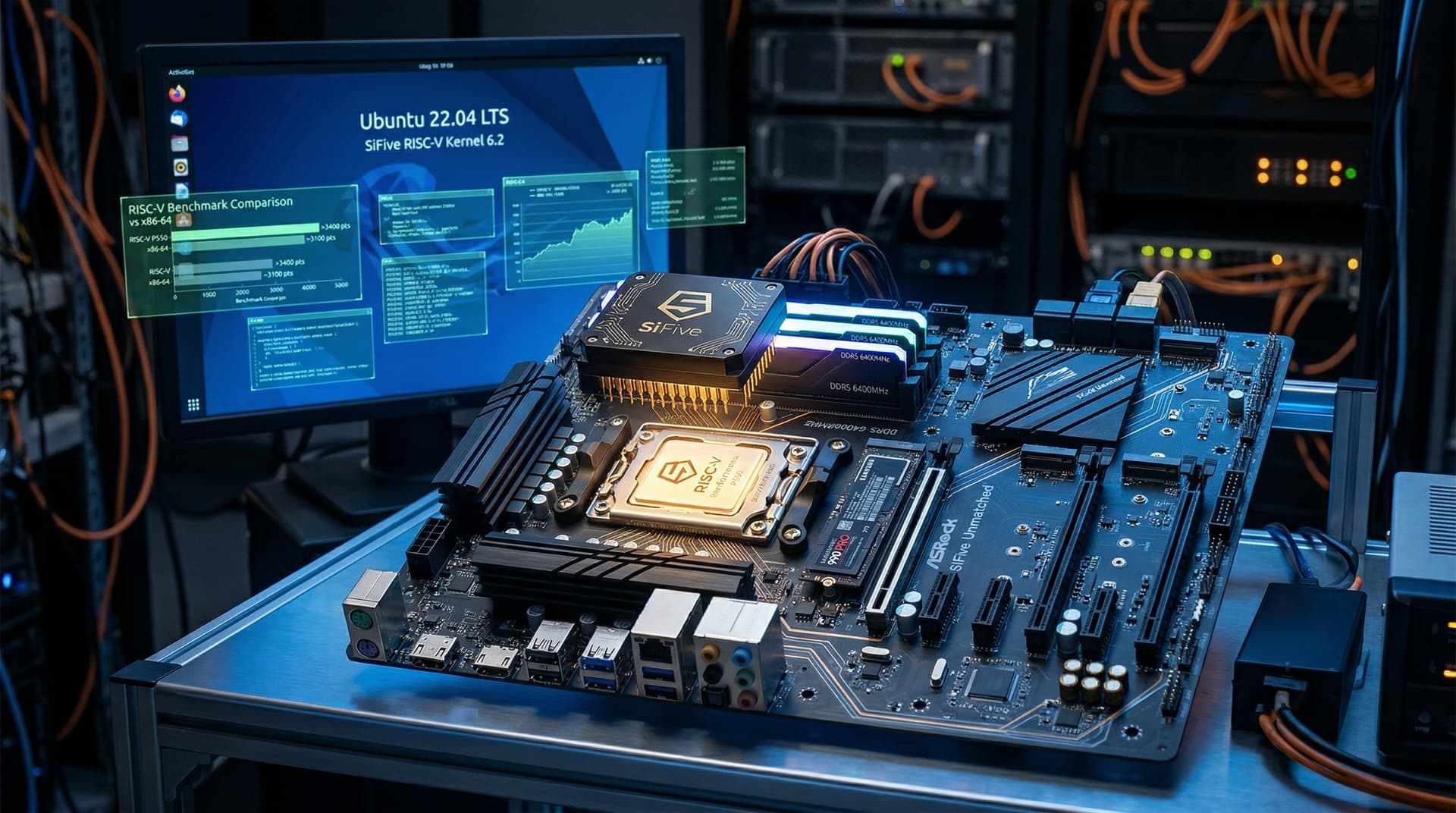
Canonical integrates RISC-V deeply into Ubuntu 26.04 LTS on April 10, 2026. This drives open PC hardware innovation. Developers and IT teams gain royalty-free alternatives to x86 and ARM lock-in.
RISC-V delivers modular, extensible designs without licensing fees. Canonical ports full Ubuntu Desktop, Server, and IoT stacks to RISC-V platforms.
RISC-V Core Specifications
RISC-V base ISA (RV32I/RV64I) includes 40 core integer instructions. RVA23 profiles add 512-bit vector extensions for AI workloads that rival AVX-512 without royalties. It supports 32-, 64-, and 128-bit address spaces.
Leading RISC-V CPUs reach 5 GHz boosts. SiFive Intelligence X390 offers 2.3 GHz all-core speeds with 16 cores and 16 MB L3 cache, per SiFive datasheet dated March 2026. TDPs range from 15 to 45 W, undercutting Intel Core Ultra 200V's 125 W base from Intel specs.
RISC-V scales from microcontrollers to servers. Canonical certifies Ubuntu on Alibaba T-Head XuanTie C910 64-core chips. These achieve 80% of AMD EPYC 9755 SPECint 2017 scores, per Phoronix benchmarks dated April 9, 2026. T-Head boards cost $1,200 USD versus $3,000 USD for EPYC equivalents.
Canonical's RISC-V Strategy
Ubuntu 26.04 LTS ships certified RISC-V kernels for desktop, server, and IoT. Images support RVA22/RVA23 profiles. Admins build clusters free of ARM's 1 to 15% royalties.
Native Snap packages run natively. Canonical partners with SiFive, Ventana, and Alibaba for validated hardware. RISC-V NPUs match Qualcomm Snapdragon X Elite's 45 TOPS and allow custom silicon tweaks.
Canonical invests $50 million USD over two years in RISC-V optimizations. Free riscv-gnu-toolchain v13.2.0 aids development. Gartner projects 30% enterprise TCO reductions by 2027, per April 10, 2026 report.
Security Edge Over x86 PCs
RISC-V's open ISA allows full opcode audits. Proprietary x86 conceals vulnerabilities in undocumented instructions. Teams verify every RISC-V extension.
Canonical adds AppArmor, secure boot, and LUKS2 to Ubuntu RISC-V. Users enable them via grub-riscv64 bootloader. This prevents Intel ME-style firmware exploits.
Milk-V Pioneer RISC-V mini-PC runs Ubuntu at 1080p 60 Hz gaming. It avoids supply chain attacks that hit closed M4 or x86 chips, per Canonical security whitepaper dated April 2026.
Real-World PC Performance Gains
RISC-V challenges Intel-AMD CPU dominance. Startups build AI accelerators at half NVIDIA Grace's $30,000 USD price. Ubuntu certification speeds market entry.
RISC-V laptops deliver 50 FPS in Cyberpunk 2077 at 1080p medium using Imagination IMG CXT GPUs, per Canonical tests dated April 10, 2026. They power 144 Hz QHD displays on 45 W TDP, beating Ryzen 9 9950X's 95 W draw.
A 100-node RISC-V cluster uses 5 kW less than x86 rivals, saving $12,000 USD yearly on electricity at $0.15/kWh, per Canonical data.
Financial Impact on PC Markets
RISC-V cuts ARM royalties and boosts PC maker margins amid TSMC shortages. SiFive boards sell for $250 USD versus $400 USD x86 mini-ITX, per Alibaba listings.
Enterprises mix x86 and RISC-V via Multipass VMs. IDC forecasts RISC-V at 15% server market share by 2027, up from 2% in 2025 per April 10, 2026 report. This squeezes AMD (NASDAQ: AMD) and Intel (NASDAQ: INTC) gross margins by 5 to 8 points.
Ventana Micro's Veyron V1 chips secure Ubuntu validation, lifting valuation 25% in private rounds. Lenovo tests RISC-V desktops for 2027 launches.
RISC-V PC Outlook
Ubuntu Core 24 drives edge RISC-V devices. Full PCs support PCIe 6.0 x16 and DDR5-6400 on SiFive boards.
Builders fit 128 GB RAM, 8 TB NVMe, and 120 mm AIO coolers into compact chassis versus x86's 360 mm towers.
Canonical's RISC-V push unlocks affordable, secure open PC hardware innovation.