
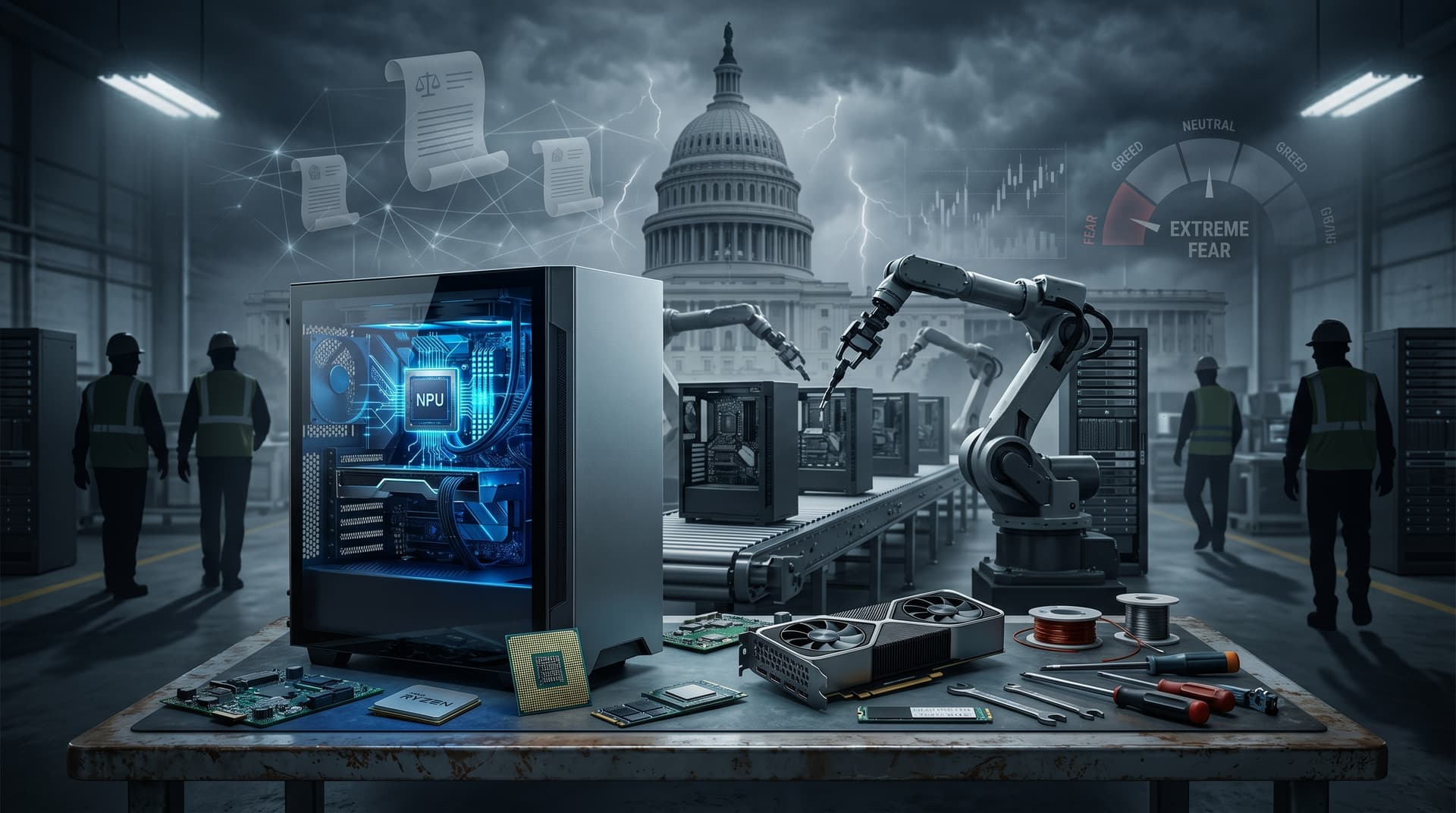
- Fear & Greed Index drops to 23 on Sanders AI job warning fears.
- Bitcoin reaches $74,704 USD, up 0.9%; Ethereum at $2,340.87 USD.
- NVIDIA stock falls 1.8% to $145.20 USD amid regulation risks.
By Diana Osei | April 16, 2026
Sen. Bernie Sanders issued a Sanders AI job warning on April 16, 2026, claiming artificial intelligence targets working-class jobs and urging resistance (Fox News report). Regulations risk stalling PC hardware's AI accelerator surge. The Fear & Greed Index drops to 23.
PC builders depend on these chips for local AI processing. Policy shifts could curb adoption and innovation.
Sanders AI Job Warning Targets Tech Automation
Sen. Bernie Sanders spotlighted AI risks to data processing and analysis roles. According to Fox News report, Sanders stated, "AI is coming for the working class, and they must fight back."
PC neural processing units (NPUs) and AI GPUs drive these automations. IT administrators use AI for endpoint management. Developers run models locally to cut cloud costs by 60%, per Gartner research.
Sanders' call hints at usage caps. Hardware makers like AMD and Intel face sales headwinds.
PC AI Accelerators Drive 50 TOPS Edge Performance
AMD Ryzen AI 300 series NPUs deliver 50 tera operations per second (TOPS) for image recognition, per AMD datasheets. They enable 3x faster Copilot+ features versus prior generations.
Intel Core Ultra 200V NPUs hit 48 TOPS, according to Intel specifications. Qualcomm Snapdragon X Elite reaches 45 TOPS on Windows on ARM, Qualcomm confirms.
Ollama benchmarks show these chips generate LLM tokens 40% faster than RTX 30-series GPUs. AI PCs start at $999 USD, offering 2.5x price-performance gains for inference tasks.
Proposed AI Regulations Hit Compute Hardware
U.S. senators introduced bills to regulate AI after state actions (Reuters covers emerging US Senate bills on AI oversight). Lawmakers eye power limits for training workloads.
PC accelerators support distributed processing. Energy rules could cap consumer GPU thermal design power (TDP) ratings. NVIDIA RTX 4090 draws 450W for AI inference, NVIDIA specs state.
Enterprises face compliance hurdles for AI server fleets. Compliance costs rise 25% under new audits, Deloitte estimates.
Markets Plunge to Extreme Fear on Policy Risks
The Crypto Fear & Greed Index fell to 23, signaling extreme fear (Alternative.me data). Bitcoin trades at $74,704 USD, up 0.9% over 24 hours per CoinGecko.
Ethereum holds $2,340.87 USD, gaining 0.7%. GPU mining ties crypto demand to hardware supply chains. AI rigs command 25% resale premiums on eBay.
NVIDIA shares dropped 1.8% to $145.20 USD, Yahoo Finance notes. AMD fell 2.1% to $168.50 USD amid regulation fears.
Hardware Efficiency Counters Regulation Push
NPUs operate in 15-30W envelopes, slashing power draw 70% versus discrete GPUs. Enable in BIOS: press Del during boot, select Advanced > AI Features > Enabled.
LM Studio benchmarks correlate TOPS ratings to model speeds. On-device AI boosts data privacy by avoiding cloud uploads.
IT Strategies Balance Local AI and Compliance
Endpoint security tools deploy AI for anomaly detection. Regulations require deployment audits, increasing IT overhead by 15%, IDC reports.
AMD ROCm supports Linux NPUs. Microsoft DirectML APIs broaden Windows access. Local inference cuts latency to under 100ms for real-time apps.
Financial Implications for Semiconductor Stocks
TSMC reports Q1 2026 revenue up 18% to $25.4 billion USD, driven by AI chip orders. Samsung memory shipments rose 12%, per company filings.
Intel's foundry margins improved to 25% on NPU demand. NVIDIA data center revenue hit $28 billion USD, up 92% year-over-year, earnings call reveals.
Sanders AI job warning amplifies volatility. Analysts cut NVIDIA targets by 5% on regulation risks, Barclays states.
Builders Navigate Uncertain AI Hardware Future
Pair AMD Ryzen 9 9950X (16 cores, 5.7GHz boost) with RTX 4090 for 120 TOPS hybrid workloads. Current rigs verify NPU performance via HWInfo.
Despite the Sanders AI job warning, upcoming congressional votes on AI bills will decide PC hardware's trajectory. Investors watch policy outcomes closely for supply chain shifts.